























Beauty giants are increasingly interested in generative artificial intelligence Why? How are they using it? What are the benefits?
There’s a silent yet unstoppable shift rewriting the foundations of the beauty industry. A change that smells not of rose or jasmine, but of bits, servers, and lines of code. It’s a revolution born not among the shelves of perfume shops or in the hushed rooms of cosmetic labs, but within the syntax of generative algorithms, trained to learn, create, and, above all, anticipate desires. The leading force behind this systemic transformation of the global beauty landscape, touching everything from product formulation to marketing, from customer experience personalization to brand storytelling, is generative artificial intelligence (GenAI). From L’Oréal to Estée Lauder, via Unilever, Coty, and luxury giant LVMH, major industry players have already launched strategic transformations powered by GenAI, which, through bytes and code, will redefine how beauty is designed, communicated, produced, and sold.
From craftsmanship to programming: the new grammar of beauty and GenAI
The cosmetics sector has always been synonymous with emotion, touch, nuance, and scent. A world that speaks through feelings, not equations. And yet, even in this deeply human domain, generative technology is finding extremely fertile ground. Why? To truly understand the impact of GenAI on the industry, we must begin with a simple yet powerful realization: beauty is no longer just an aesthetic language. It has become an expression of identity, culture, and personalization. This is where generative AI thrives. Because today, selling a lipstick or a face cream doesn’t just mean offering a product, it means building a narrative universe around the individual’s experience. Doing this at scale, consistently, locally, empathetically, and hyper-responsively, is nearly impossible for a purely human workforce. “In beauty, we don’t just sell products. We sell dreams, identity, experiences,” says Guilhem Souche, former L’Oréal executive and now advisor at Sthrive.AI. “GenAI is our new storyteller: capable of writing, testing, editing, and distributing at speeds no human creative team could match.”
The most impacted areas: R&D and Marketing
The integration of generative AI has tangible impacts especially in Research and Development (R&D) and marketing. Thanks to its ability to analyze large-scale data and anticipate market trends, it allows companies to develop products increasingly aligned with consumer expectations. In some cases, consumers themselves participate in co-creation processes, providing personalized input through interactive, AI-powered platforms. In marketing, GenAI enables the fast, localized production of content that remains consistent across platforms. Companies like Coty can generate thousands of tailored visual assets in minutes, while newcomers like e.l.f. Beauty experiment with combining voice search, augmented reality, and automated campaign optimization. Operationally, the benefits are equally significant: AI enables more accurate inventory planning, reduces waste, and improves logistics, ensuring large-scale efficiency for giants like L’Oréal and Estée Lauder.
From virtual try-on to predictive skincare: retail gets a makeover
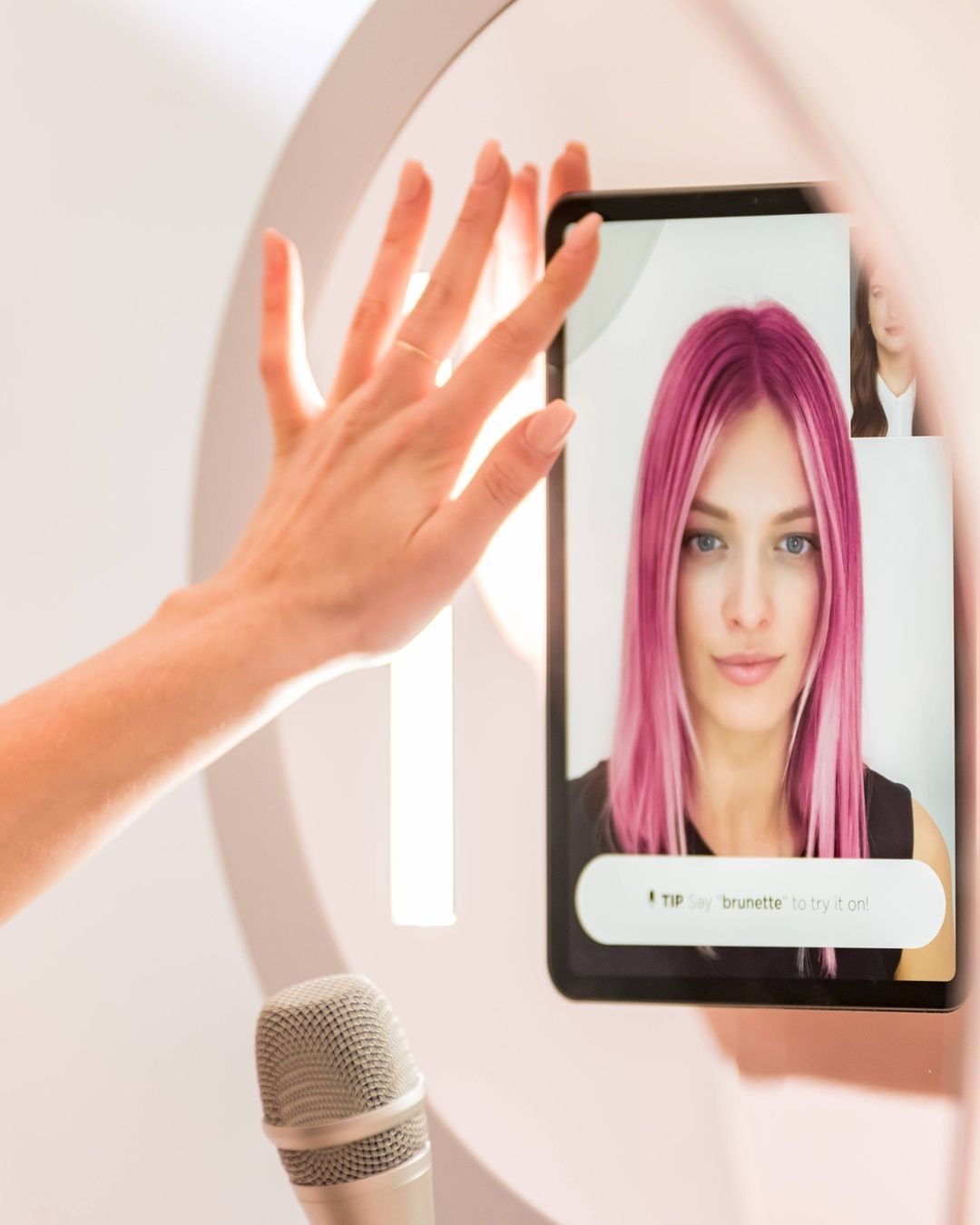
Brands are increasingly turning to GenAI in both physical and digital retail. Imagine entering a store and seeing your face reflected not in a static mirror, but in an interactive, smart display. It suggests the perfect foundation for your undertone, a personalized serum for your skin type, or a look inspired by the latest social moodboard. Through a combination of computer vision, machine learning, and dermatological databases, GenAI-powered apps can now build a fully customized, up-to-date, validated skincare routine in seconds.
What are the big beauty players doing?
According to a recent GlobalData report, over 40% of companies have already seen concrete impacts from AI in their operations, with another 13% expecting significant changes within the next year. The most dynamic segment? Generative artificial intelligence, with projected growth expected to exceed $33 billion by 2027. L’Oréal, historically a pioneer in beauty innovation, has partnered with IBM and Nvidia to launch a full-fledged Content Lab where AI not only creates ad content but also contributes to predictive product formulation. The result? Shorter development cycles, more sustainable formulas, and customized messaging for every audience. This initiative aligns with their L’Oréal for the Future plan, aiming for 95% sustainable products by 2030. Estée Lauder, meanwhile, has merged creativity with GenAI via a partnership with Microsoft, accelerating every phase of product development. Launch cycles have dropped from months to weeks, with campaigns that are perfectly localized while maintaining a consistent global tone. Unilever, the multi-brand giant, is betting big on GenAI, integrating over 500 AI-powered tools across its value chain, from predictive skincare algorithms, to automated high-conversion content creation, and real-time supply chain and feedback management. Lastly, Coty began experimenting with AI avatars for live commerce in Asia as early as 2021. Today, it generates thousands of personalized content pieces for different markets and cultures in just minutes, adapting every image and copy to its specific micro-target.
Risks and responsibilities: privacy, ownership, regulations, and ethics
Every tech revolution casts shadows, and in the realm of beauty, those shadows can be particularly insidious. If an algorithm generates the image of the “ideal woman,” who decides which features to highlight? If GenAI unknowingly removes wrinkles, scars, or ethnic traits to “optimize” a campaign, is it betraying the very essence of diversity? That’s why Dove was the first beauty brand to commit to never using AI to represent women in its advertising. The issue of intellectual property is just as complex. Who owns an image generated by AI? The company? The software? The human who prompted it? And in cases of offensive or culturally insensitive content, who is responsible? In regions like Europe, where regulations like the AI Act are already governing the use of biometric data and algorithmic transparency, these questions are no longer theoretical. They are urgent, tangible, and vital. “AI is a powerful tool, but not a neutral one,” warns Guilhem Souche, AI advisor for the beauty sector. “It can uplift diversity, but also flatten it. It can be inclusive, but also homogenizing. It’s up to us, the humans, to guide its intelligence.”
The future of beauty is hybrid, human, and intelligent
Today, the rising interest in GenAI across the beauty sector is a strategic advantage. Startups like Topview.ai and initiatives such as LVMH’s AI Factory are drawing investments and partnerships. The real challenge lies in integrating this technology into the core of business operations, without compromising brand identity. In a world where emotions and identity are at the heart of what’s sold, GenAI must not replace creativity but enhance it. It should amplify engagement, not sterilize it. Because beauty, ultimately, is a human language, a subtle code made of emotions, imperfections, gestures. Artificial intelligence can help us understand it, tell its story more effectively, adapt it across countless voices. But it will never replace the unique glance a person casts at themselves in the mirror. The brands that lead the future will be those that bridge the gap between the infinite possibilities of algorithms and the poetic fragility of identity. Because even in a data-driven world, true beauty cannot be measured in pixels, it is seen in the eyes. And for now, at least, we humans still read those best.