













Clavicular is a cultural problem A critical portrait of the king of looksmaxxing, from the undergrowth of the manosphere to the catwalk of NYFW
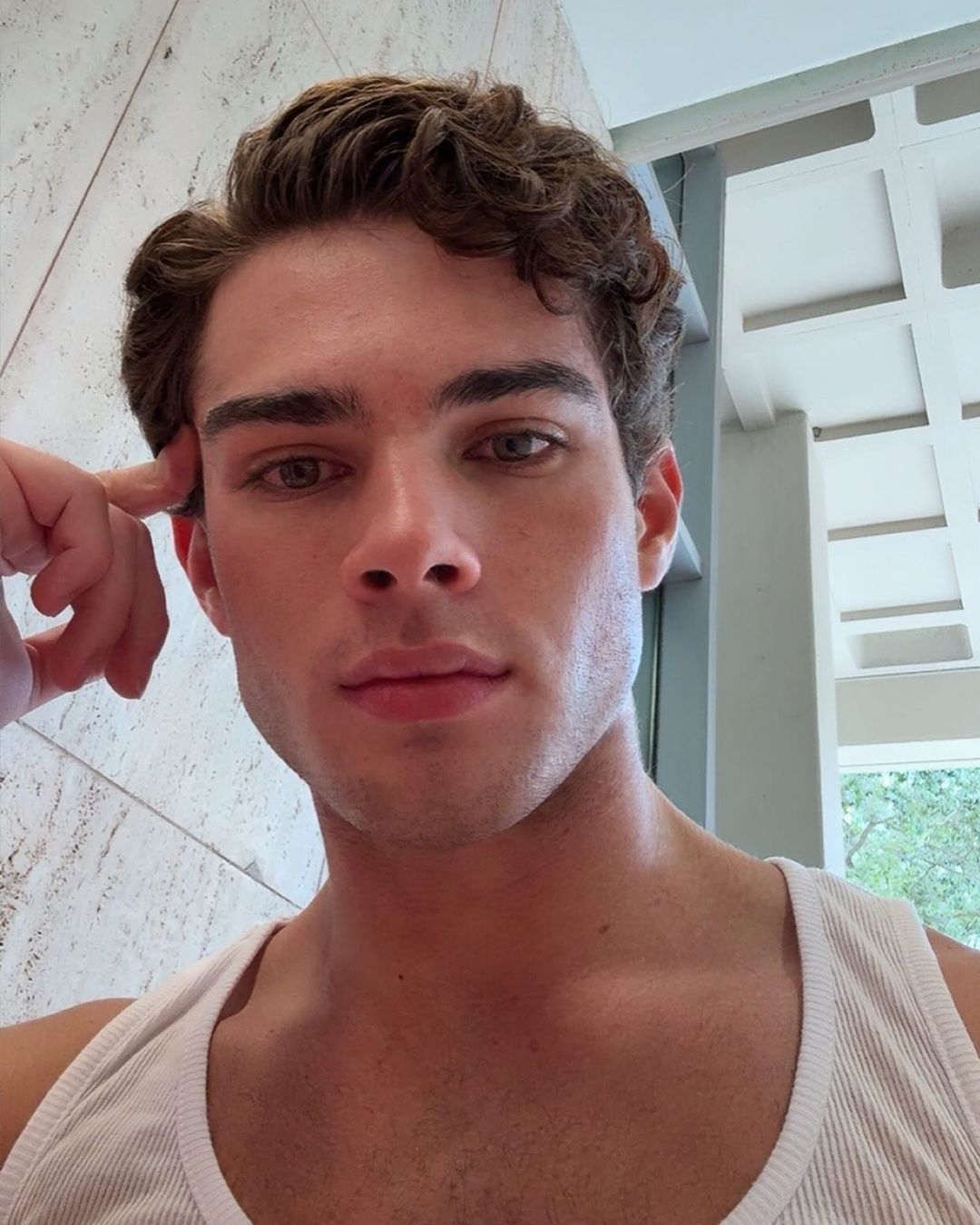
Big green eyes. A square jaw. A toned, muscular body. The guy who closed the FW26 show by Elena Velez at the last New York Fashion Week looks like any other model. But he isn’t. A quick dig online reveals that the twenty-year-old earns more than $100,000 a month from Kick, refers to women as "targets" or "foids" (short for female humanoids), spends time with the misogynistic influencer accused of sex trafficking Andrew Tate and the white nationalist commentator Nick Fuentes. And, by his own admission, he has undergone bone smashing (breaking facial bones to stimulate regrowth), performed dick-ups by placing weights on his penis to increase girth and erectile strength, injected testosterone since the age of 14, smoked methamphetamine to burn fat, and taken drugs such as beta-blockers and retatrutide. His name? Officially he is Braden Peters, but he is known as Clavicular.
Looksmaxxing today, anatomy of an obsession
If every era builds its own mirror, ours no longer merely reflects. It calculates. It has the shape of a front-facing camera and the language of an algorithm. It compares, ranks, archives. The image is no longer an ambiguous experience between gaze and desire, but a variable that can be translated into ratios, metrics, rankings. In this culture of permanent measurement, beauty stops being a relational fact and becomes a question of parameters. Clavicular is one of the most systematic embodiments of this transformation. Twenty years old, hundreds of thousands of followers across TikTok and Kick, and a vocabulary born in extreme niches that has now settled into the mainstream in the form of memes. His trajectory, from incel forums within the manosphere to the runway of New York Fashion Week, is a coherent path inside an imaginary that has internalized a simple and brutal idea: that the body is a technical project and beauty a problem to be solved. At the center of this project is a specific face, adopted as a unit of measurement: that of Matt Bomer, considered “the most harmonious male face in the world”. Clavicular does not want to merely “look like” Bomer in the generic sense of admiration; he wants to reduce the morphological distance that separates them.
Who is Braden Peters
Before becoming Clavicular, Braden Peters was simply a young American growing up inside suburban normality (more precisely in Hoboken, New Jersey) and digital exceptionality. His biography, filtered through livestreams, tells the story of a path marked by successive obsessions. First Nerf guns, then Rich Piana on YouTube, then bodybuilding forums, and finally Looksmax.org. At 14 he ordered testosterone online. At 19 he declared that he might be sterile. He became a moderator of the forum and offered himself as a “lab rat for the community”. College lasted only three weeks before he was expelled for possessing steroids in the dormitory. His expulsion from college marks a key turning point. Not so much for the episode itself, but for its transformation into a founding myth. The institution rejects him and the individual chooses another form of legitimacy: visibility. From there, the transition to monetizing his own journey is almost logical. Daily streaming, detailed accounts of hormonal cycles, discussions about facial proportions and improvement strategies. In this way, Braden Peters stops being Braden Peters. He becomes Clavicular, a nickname derived from the community’s fetish bone within the looksmaxxing subculture, an online environment that considers male attractiveness the primary lever of social power. In this cosmology, the jawline matters more than character, symmetry more than ethics, the clavicle more than biography. Height, body-fat percentage, facial proportions, mandibular angles… every detail becomes the object of an analysis in which the body is measured with an attention that resembles philology more than narcissism. Aesthetics here becomes a science applied to the self, a form of amateur bioengineering promising salvation through measurement. In this universe, mathematics is normative. If symmetry is virtue, then beauty is a moral equation. Clavicular presents himself as a living demonstration of the thesis that man is an optimizable project.
What looksmaxxing is (and why it’s not just about the gym)
To understand Clavicular, we need to return to forums such as 4chan, Reddit, and the post-incel offshoots of PUAHate and Sluthate. It was there, inside the murky galaxy of the manosphere, within incel forums in the early 2010s, that looksmaxxing was born. The core idea is simple to the point of brutality: appearance determines access, desirability, status. If you are handsome, you are sovereign. If you are ugly, you are condemned. The only solution? To “ascend.” There is a presentable softmaxxing that includes diet, gym routines, and strategic haircuts, and a hardmaxxing that flirts with surgery, hormones, and biomedical risk. Clavicular stands on that threshold, pushing the bar toward the extreme. Risk becomes aestheticized; danger, monetized. But the point is not excess itself. It is the grammar that makes it plausible. In an ecosystem where the body is capital, aggressive investment becomes rational. If identity is a brand, surgery is rebranding. Looksmaxxing thus becomes an ideology of permanent optimization, perfectly aligned with platform capitalism, for which there is no such thing as “enough.” There is only a before and an after. And the after can always be improved.
Mogging and hierarchy: aesthetics as competition
Within this system, mogging represents the social translation of the theory. To “mog” someone means to aesthetically outclass them to the point of turning them into background, an extra, a footnote. How? By making one’s own physical superiority evident in direct comparison. In Clavicular’s videos, the gesture is often simple. He approaches another man, stands beside him, and lets the viewer judge the difference. Aesthetics thus becomes a low-intensity duel, a cold war of clavicles and cheekbones. The winner does not conquer territories; he conquers gazes. The loser does not lose blood; he loses aura. The vocabulary surrounding mogging (slaymaxxing, jestermaxxing) functions like a cultural password. It is jargon that builds community while also raising barriers. There is an inside and an outside, an initiate and a normie. Continuous comparison produces a cohesive community but also constant tension. Because in a system based on permanent comparison where male competition is pushed to the extreme, no one is truly safe.
From niche to mainstream
Clavicular describes himself as apolitical. He says he will support whoever offers him “the fattest bag”. Yet he was filmed in a nightclub singing Heil Hitler by Ye with Tate and Fuentes. He dismisses accusations of racism as “stupid.” He uses insults with performative lightness. The truth is more complex than the caricature. He is not a structured ideologue. Rather, he is an algorithmic opportunist. For him, the manosphere is not an end but an audience pool. He shares with those worlds an aesthetic of transgression and a contempt for vulnerability. But his true cult is form. And yet, in his online program Clavicular’s Clan, women become “targets”. Universities are described as “target-rich environments”. Seduction is framed as a tactical progression rather than an encounter. This is where irony becomes a system. Nihilism disguises itself as a meme. His rise has been meteoric. Appearances with streamers, conservative podcasts, millions of views on TikTok. Then the paradoxical consecration on the runway of Elena Velez at New York Fashion Week. Velez is known for her provocative shows, her aesthetics of bodily modification, and her flirtation with post-woke iconoclasm. Steel corsets, facial bandages, dental braces worn as ornaments. In that context, Clavicular, beyond being a tool for visibility, becomes a symbol. Fashion, which has always metabolized conflict, absorbed him too. Not to absolve him, but to use him. Attention is the currency of the present. And Clavicular has plenty of it.
Self-optimization, the algorithm, and the void
The path leading from the digital undergrowth of the manosphere to a NYFW runway is not linear, but it is not accidental either. It is the typical trajectory of subcultures when they encounter the attention economy: first they radicalize in tight niches, then they are intercepted, aestheticized, repackaged. Clavicular is one of the most legible cases of this process. His trajectory should not be interpreted as mere provocation or an eccentric episode. Rather, it is the coherent outcome of a cultural environment in which the body is capital, identity is performance, and optimization is a moral imperative. If productivity, skills, and relationships can be improved indefinitely, why not the body? The risk is not only physical or psychological. The deeper issue concerns our relationship with self-improvement. If everything can be improved, nothing is sufficient. If the self is an algorithm, error becomes a calculation mistake. Hell is not ugliness — it is the infinite update. One more intervention, one more cycle, one more comparison. The algorithm demands retention, and retention demands escalation. One more millimeter. One more clip. One more mogging. In this sense, Clavicular is less an exception than a mirror. He reflects a culture that measures everything and forgets to ask why. That mistakes metrics for meaning. That confuses the body with the brand and the brand with destiny. In the end, the clavicle is just a bone. But in the symbolic economy of looksmaxxing it becomes the axis of the world. And when that axis can be shifted by a millimeter, the world never stops spinning.
What to read next

Raye is the protagonist of Zalando's most ambitious cultural project ever
It's called Access All Areas (AAA) and it will take place on April 25 in Berlin