






















The eternal return of the sacred And there are those who speak of religious psychosis
There is something deeply contradictory about the fact that, in an increasingly secular era, fashion and pop culture continue to look toward the sacred. Crosses, halos, veils, clerical silhouettes: symbols originally created to separate the divine from the profane are now systematically absorbed into contemporary visual language. But reducing everything to a mere aesthetic obsession would be simplistic: the point is not so much that fashion uses religion (it has done so for a long time, at least since the early 1990s) but how, and above all why, it continues to do so today. Religion, before being a complex system of rituals and beliefs, is a system of signs. A visual language codified over centuries, made up of rituals, hierarchies, colours, gestures and garments. In this sense, it is one of the last symbolic archives still intact: immediately recognisable, universally legible, yet layered enough to be constantly reinterpreted. It is no coincidence that fashion, which by nature relies on strong and shared imagery, finds in the sacred a grammar that is already available and incredibly resistant to time.
Rosalía’s sacred imagery
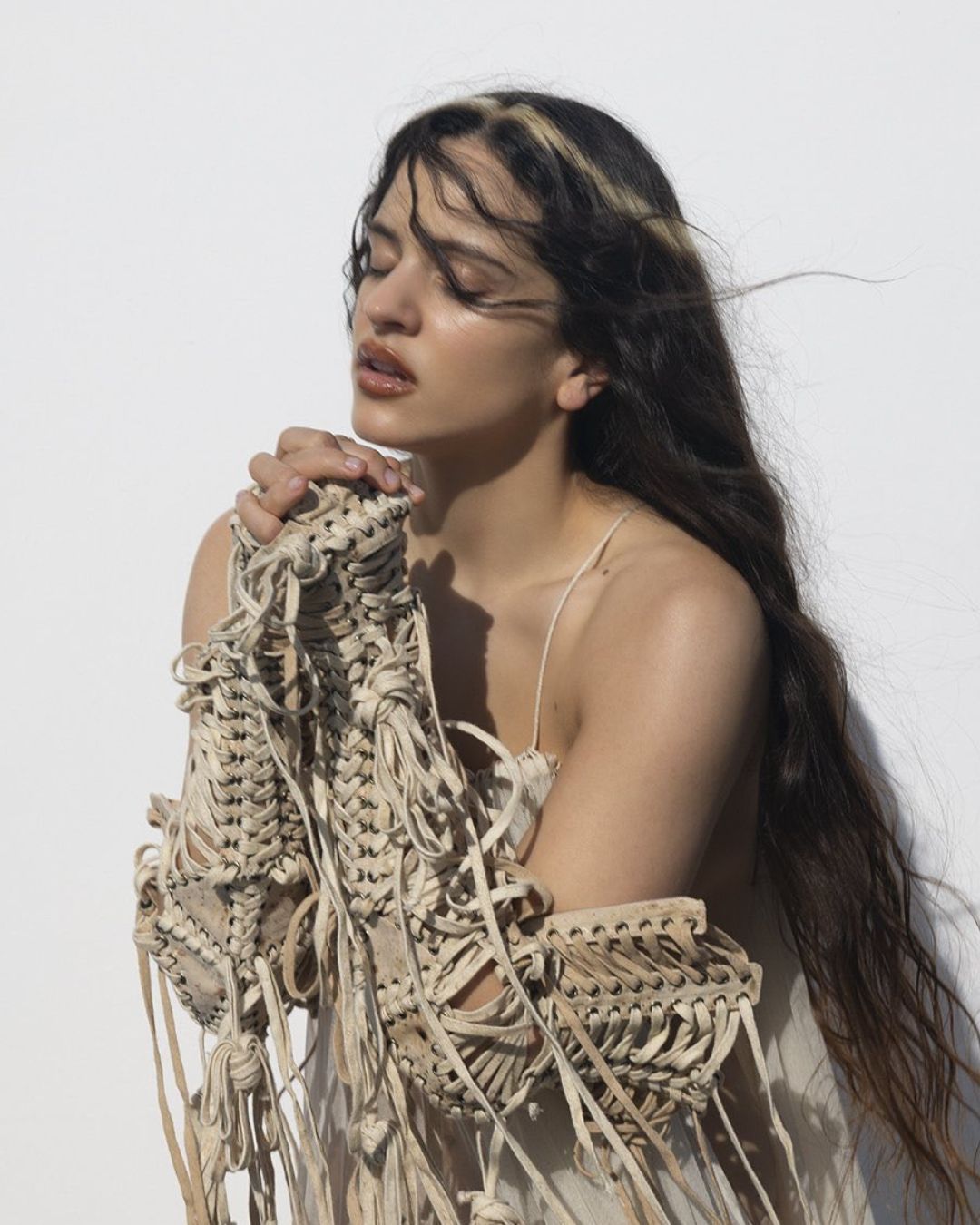
For decades, however, the use of religious symbolism was tied to a logic of disruption, rooted in an almost necessary tension between the sacred and the profane. Today, that dichotomy seems to have softened. Not because the symbols have lost meaning, but because the cultural context has changed: in a saturated visual landscape, where everything has already been shown, even transgression has stopped feeling radical. It is precisely within this space, or rather, this zeitgeist, that projects like Rosalía’s take shape. The imagery of her latest album Lux draws from a religious dimension that is neither ironic nor provocative, but deeply embedded in the culture she comes from. Popular devotion, rituality and the sense of community are not questioned, but rather reactivated. There is no critical distance, nor a desire to desacralise: if anything, there is a form of reappropriation. As if the sacred could once again become a living language, and not merely an aesthetic reference.
Madonna, provocation and the 2018 Met Gala
This approach marks, in some ways, a sharp break from the past. When Madonna, throughout the ’80s and ’90s, incorporated crosses and Catholic iconography into her imagery, she did so to destabilise. Her gesture worked because it existed within a system still governed by taboos: to profane meant to expose oneself, to take risks and provoke a reaction. Today, that same gesture feels almost harmless. Not because it has lost its power in itself, but because the context that once made it scandalous no longer exists. One of the clearest turning points was perhaps the 2018 Met Gala. With the theme Heavenly Bodies: Fashion and the Catholic Imagination, religion officially entered the fashion system as a legitimate object of aesthetic exploration. No longer marginal or disruptive, but institutional. The sacred was displayed and made accessible, and in the process it lost part of its confrontational charge while gaining a new function: that of a shared symbolic repertoire.
Fashion and the sacred today
From that moment onward, the way fashion uses religion changed profoundly. It is no longer about opposing the sacred and the profane, but about working within that language itself. Balenciaga, for example, distils its most austere aspect, transforming it into silhouettes that evoke discipline and control more than spirituality. Maison Margiela focuses on rituality, mystery and anonymity as forms of transcendence. Dolce & Gabbana, meanwhile, brings the sacred back to a cultural and territorial dimension, where religion and identity coincide. It is not so much the symbol itself that matters, but the way it is reactivated. This transformation is equally evident in pop culture. Artists such as Chappell Roan use liturgical codes to build narratives around identity, belonging and conflict. The sacred is no longer something to violate, but a space to move through.
Giving spirituality its weight back
What emerges is not a return to religion in the traditional sense, nor a truly shared form of spirituality. Rather, it is a necessity. In a cultural system that has progressively emptied symbols of their original meaning, religion remains one of the few languages still capable of suggesting depth and transcendence. The paradox lies exactly here: the further the world moves away from the sacred, the more fashion - and culture as a whole - seems to need it. Not in order to believe, but to signify. Because in a present where everything is immediate, accessible and consumable, the sacred still represents something that resists: an idea of limit, mystery and distance. And in this sense, the truly radical gesture today is no longer to profane it, but to attempt to restore its weight.