













































Digital Product Passport: what it is and why it will change how we shop How products are becoming transparent, traceable, and connected over time
For years, we’ve bought clothes by looking at what was right in front of us: the shape, the color, the price, the label on the tag. Beyond that, we knew very little. It wasn’t clear where a garment really came from, who made it, what materials it contained, or what processes it went through before arriving in store or at our doorstep. That information existed, but it was scattered across suppliers, documents, and different systems, hard to piece together and even harder to understand.
What is the Digital Product Passport and why it’s changing everything
Today, that story can finally emerge. With the Digital Product Passport, a product is no longer just something you buy and use. It becomes something that can tell its own story, a point of access to data that was previously fragmented across systems and stakeholders: origin, materials, processes, certifications, impacts, journey. But the point isn’t just having more information. The real shift is that the product stops being silent. It becomes a connection point between brand and customer, even after purchase.
From transaction to relationship: the product becomes a touchpoint
The relationship no longer ends at checkout. It can continue over time, evolve, expand, become more useful and more transparent. A garment is no longer just a static object, but something that accompanies, informs, and creates connections. Between those who produce and those who buy. Between the brand and its supply chain. Between the present of the product and everything it carries with it.
The data problem: why transparency is complex
Behind this transformation, however, there’s more than just a code to scan. There’s a significant effort required to collect the right data, organize it, connect it to company systems, and make it reliable. In other words: ensuring that story is true, readable, and useful. This is exactly the kind of challenge that Iris Skrami, entrepreneur and co-founder of Renoon, focuses on today, after working on digital innovation projects for companies like Nike, Luxottica, and PVH. In complex environments, where product data exists but is distributed across systems, suppliers, and departments, the real obstacle isn’t a lack of information, it’s fragmentation.
European regulations: what changes with ESPR
This scenario is becoming increasingly urgent to address because, at the European level, with the Ecodesign for Sustainable Products Regulation (ESPR) coming into force in 2024, the Digital Product Passport is being introduced as a requirement to make product information accessible, structured, and verifiable throughout its entire lifecycle. The first application requirements for priority sectors, such as textiles and apparel, are expected starting from 2027, making it essential for companies to begin structuring data and systems today.
How brands are applying the Digital Product Passport
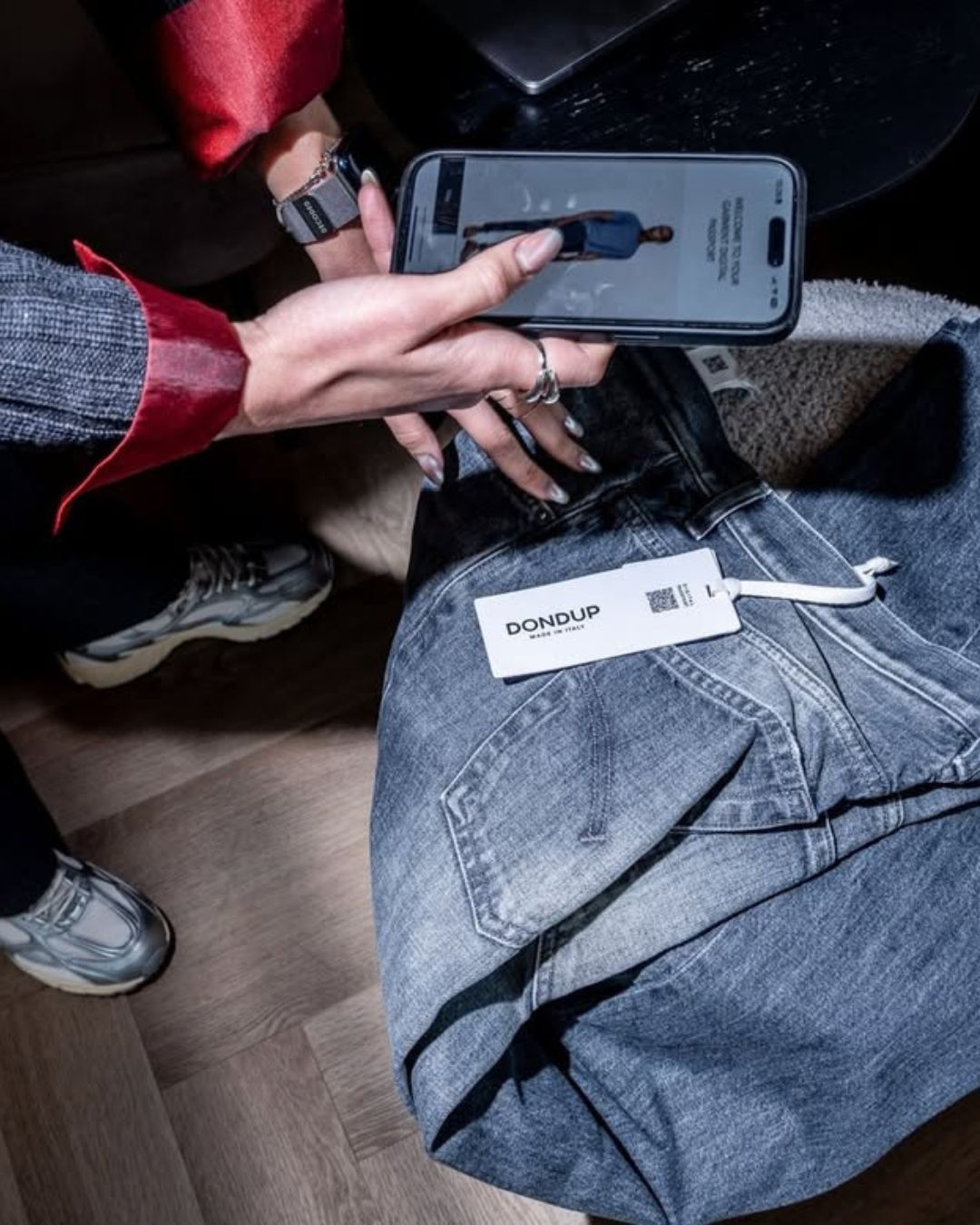
This is where Renoon operates: transforming scattered product data into systems that companies can actually use—and that people can understand. The brands it collaborates with are already numerous, both in Italy and across Europe. These include Dondup and Artknit Studios, while at a European level the work involves over 30 companies. In the case of Dondup, the Digital Product Passport is applied to one of fashion’s most complex supply chains: denim. Through product data structuring and traceability of production processes, the project makes typically opaque steps visible, offering a more concrete and accessible level of transparency for consumers. At the same time, the product becomes a point of direct contact with the customer, enabling new forms of relationship, personalization, and long-term engagement.
Technology and sustainability: the Ganni case and satellite data
Among the most significant projects is the one developed with Ganni, together with EUSPA, to integrate Copernicus satellite data and closely observe biodiversity and environmental dynamics along the supply chain. At Copenhagen Fashion Week, where Renoon is the official technology partner, it became clear that the Digital Product Passport is evolving into something far beyond a regulatory tool. Increasingly, it appears to be a new product infrastructure: a way to make products more transparent, more connected, and ultimately closer to people.
What to read next

The analog is back, even in the way of dressing
For a more authentic and less constructed look

Rubinacci has launched its first ready-to-wear women's collection
The lifestyle journey between past and present told at the trunk show on October 7