


























Four books (plus one) to read today In a complex publishing world, something remains
Every year, books are published that take up space before they are even read. Some become phenomena, others remain on the margins despite their quality. This is not an attempt to separate “good” and “bad” literature, but to understand what happens when a book enters the attention circuit: what holds up, what gets consumed, and what continues to work long after. Four recent titles, between 2025 and 2026, clearly reflect this unstable balance.
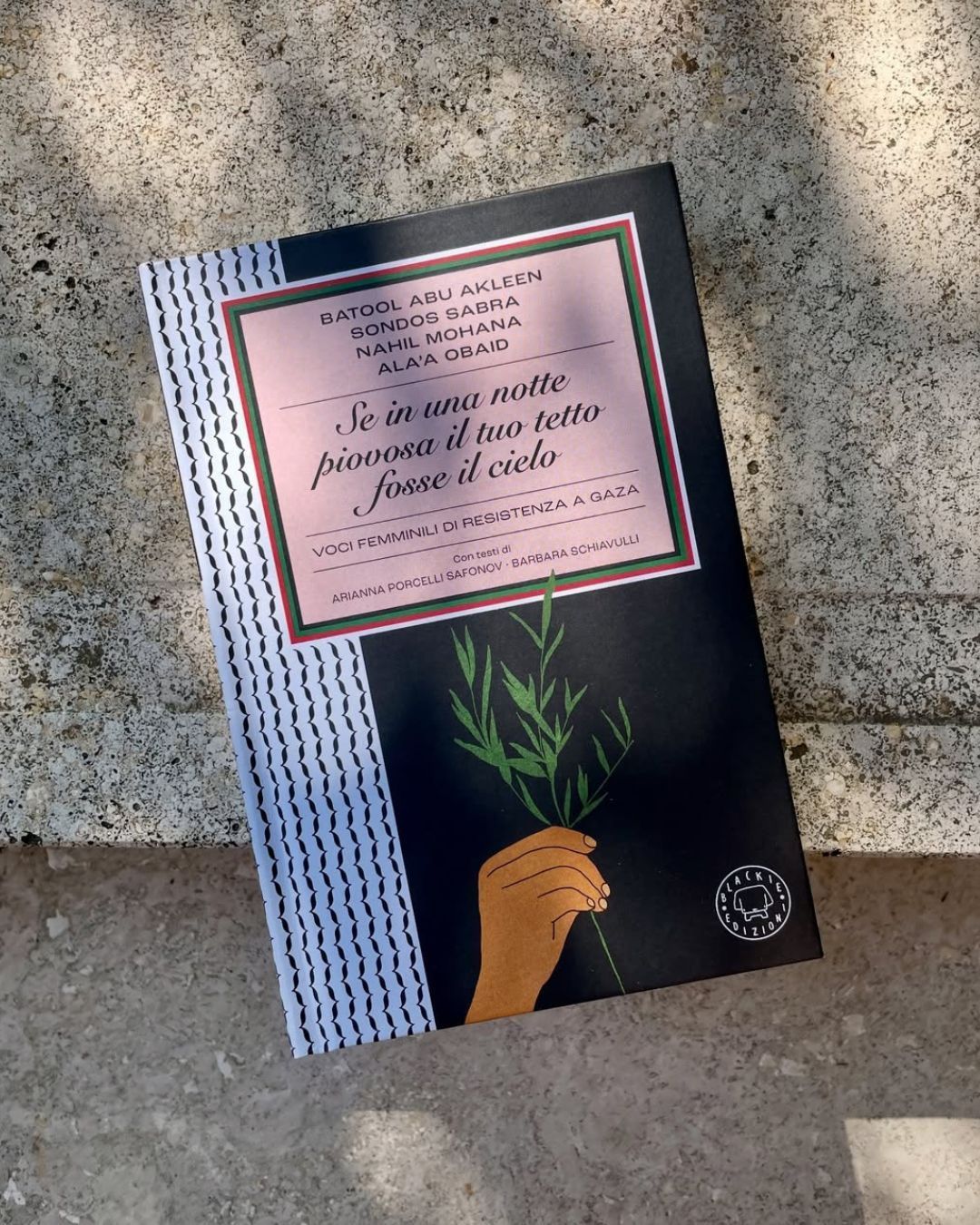
If on a Rainy Night Your Roof Were the Sky - Blackie Edizioni (2026)
This book was not created to be “positioned” within the publishing market, and in fact it transcends it. It is a collection of testimonies and diaries by Palestinian women in Gaza, written during a time of crisis and later assembled into a choral form. There is no traditional literary mediation: no narrative construction that softens or aestheticises the content. The writing refuses to turn war into spectacle, as war becomes a total, continuous background that invades without ever becoming an “event.” The focus is not on grand gestures, but on the sustainability of everyday life: cooking, protecting children, remembering, writing. Minimal actions that become infrastructures of survival. The roof turning into the sky is not a symbolic opening toward freedom, but the description of a world in which the space for freedom has been reduced almost to disappearance.
Onyx Storm - Red Tower Books (2025)
It is one of the most prominent publishing phenomena of 2025 in the romantasy genre, and one of the most debated even beyond its core audience. Rebecca Yarros continues a saga that has become a global phenomenon, fuelled by TikTok, fandom culture, and serial reading. But reducing it to an algorithmic product would be a mistake. The book works because it captures a very specific contemporary reading experience: immersive and emotional, where one reads not just for plot, but for the intensity of engagement. The world built by the saga is made of power, desire, body, and female identity intertwined in a continuous flow. It is an imaginary that does not aim for reduction, but excess. Structural limits exist, but they have not prevented its success.
Atmosphere - Simon & Schuster (2025)
Taylor Jenkins Reid is now one of the authors who best understands how contemporary pop narrative works. In Atmosphere, she builds a story that seems to operate along familiar coordinates - fame, relationships, desire, success - but actually revolves around a deeper question: what does it mean to be “yourself” when every version of you is also a performance? Her writing is linear and accessible. The book reads like entertainment while continuously introducing tension around identity and its instability. It is a novel that uses the most readable form possible to speak about something that is never stable: the construction of the self.
Great Big Beautiful Life - Berkley (2025)
Emily Henry is arguably the most recognisable voice in contemporary mainstream romance, and this book confirms it. Great Big Beautiful Life operates within an apparently light grammar, but beneath the surface it builds a more precise structure. The core of the novel is not the love story itself, but the way characters attempt to be read by others. The question is not only who they love, but how they want to be interpreted.
Bonus: Il prodigio - Mondadori (2025)
In his literary debut, Fabrizio Sinisi constructs a contemporary parable that begins with a simple yet disturbing image - a childlike face appearing in the sky over a large Italian city - and transforms it into a total narrative device. What initially seems like a visual or atmospheric phenomenon gradually accumulates religious, political, and social meanings, generating movements, sects, and new figures of spiritual power. At its core remains a question that runs through the entire novel without ever closing: what happens when the inexplicable breaks into public space and becomes an object of faith, consumption, and conflict?
In the end, what connects these books?
Not literary value in the traditional sense, nor commercial success. What connects them is the way they respond to the same contemporary question: how do we tell a life today, and above all, who has the right to tell it.
