


















Paris Hilton, the DJ: the blonde who remixed fame The pop, controversial, and surprisingly strategic story of Paris Hilton
I was talking with two twenty-something guys, digital natives raised on bread, streaming, TikTok, and Minecraft, when, I don’t even remember how, the name Paris Hilton came up. Silence. No associations, no images. Paris Hilton, for them, was a blank field. And in that moment I felt a kind of generational gap, not so much in age as in culture, as if a figure who had once been everywhere had simply dissolved into nothing. I improvised, trying to reconstruct her in words. Heiress, luxury hotels, reality TV, early 2000s, paparazzi swarms alongside Britney Spears, famous for being famous, proto-influencer before the word even existed. On my way home, though, an uncomfortable feeling stayed with me: what do I actually know about her? If someone asked me today who Paris Hilton is, I would hesitate. Because there isn’t just one answer, and because the truth is that Paris Hilton has always been more narrated than heard. And meanwhile, while we archived her as an icon of a bygone era, she kept transforming herself. Entrepreneur, reality TV star, artist, perfumer, model, socialite, mother… and DJ. Yes, you read that right.
From gossip to empire: before the decks, the brand
Before ever touching a DJ console, Paris Hilton had already built something closer to an economic system than a career. Reducing her to a “socialite” has always been a convenient way to simplify what is, in reality, a perfectly oiled machine of branding and monetization. Her fortune, estimated at around 400 million dollars, is only the tip of an iceberg that has surpassed 4 billion in global revenue. More than 19 product lines, a capillary presence in global retail, a name that spreads like a liquid logo across every available surface: clothing, accessories, fragrances, pet products, lifestyle. Even NFTs and virtual reality projects. Because the future, if you are Paris Hilton, is not something you wait for—you brand it. In this context, Paris Hilton’s move into DJing looks like yet another strategic expansion. If you are the brand, every expressive platform becomes new territory to occupy. But perhaps it is something more.
@zachsangshow @ParisHilton explains why she decided to start DJing #parishilton #DJ #club #dancemusic #edm #ibiza #zachsangshow #zachsang #fyp #foryou @Amazon Music original sound - Zach Sang Show
The birth of Paris Hilton the DJ
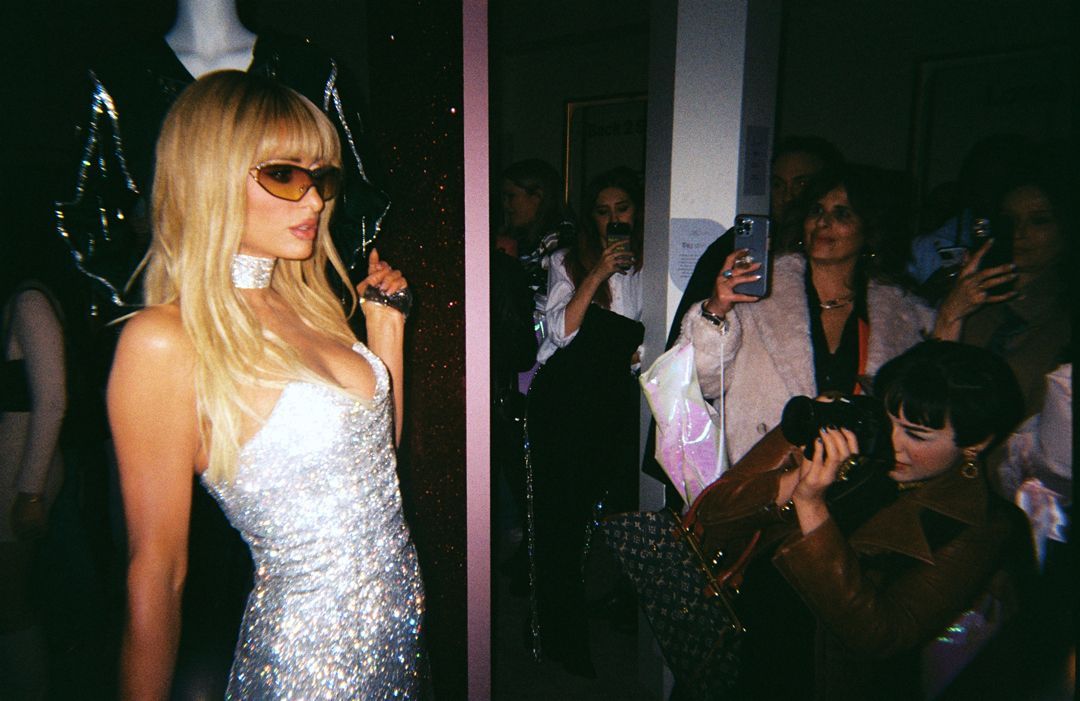
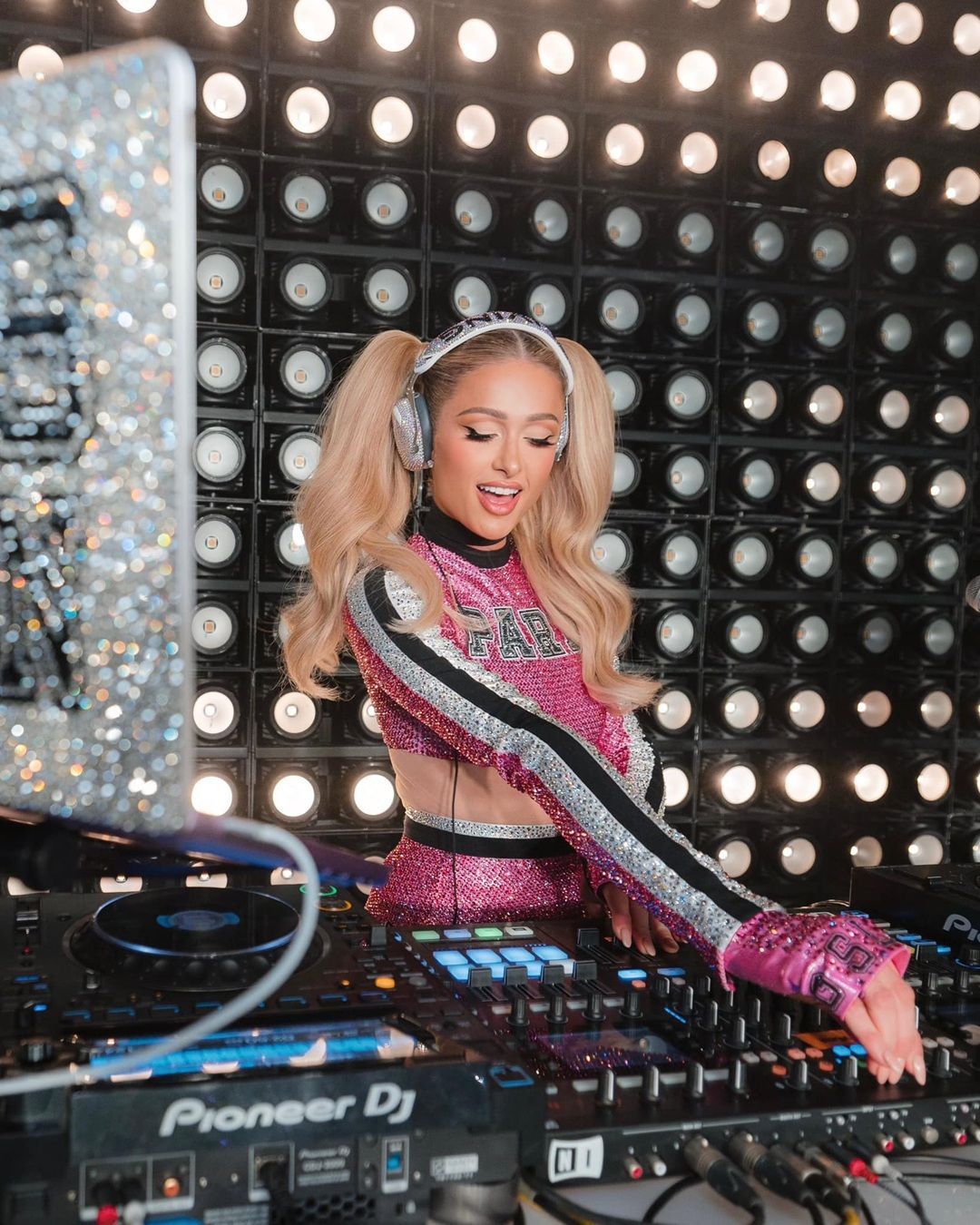
The emergence of Paris Hilton the DJ comes at a very specific historical moment, when the role of the DJ is undergoing a radical transformation. No longer just a selector of vinyl in underground spaces, but a global performer, festival headliner, campaign face, a figure halfway between musician and influencer. Paris intercepts this shift with almost surgical timing. In the early 2010s, as EDM dominates the charts and DJs become superstars, she enters the scene with the awareness of someone who already knows how attention works. In 2012 she officially debuts as a DJ at a pop festival in Brazil. From there she begins performing in clubs, eventually securing a five-year residency at Amnesia club in Ibiza and playing multiple times at Tomorrowland, the world’s biggest dance music festival. In 2014 she signs another residency, this time at Harrah’s in Atlantic City, and embarks on a tour that consolidates her presence in the scene. By the end of that same year, she is already the highest-paid female DJ in the world, with fees reaching nearly one million dollars per set. Controversial numbers, certainly. But Paris didn’t enter DJing to participate. She entered to dominate it on her own terms. Today she spends more than 250 days a year traveling to perform, turning the DJ booth into a mobile extension of her brand.
@theburnouts Paris Hilton Invented Celebrity DJing! #parishilton #theburnoutspodcast #podcastepisode #founderstories #iconicinterviews original sound - The Burnouts
The sound: between EDM, nostalgia and crowd control
The Paris Hilton DJ sets are not designed to impress purists. They are built to work. EDM, electro house, pop, classic remixes, 2000s references. It’s a smart jukebox, calibrated for a global audience. The goal is not to impress the musical elite. Her sets are designed as emotional devices, built to activate the crowd, generate immediate recognition and participation. In a recent improvised DJ set in Herald Square, on top of a double-decker bus for a Karl Lagerfeld campaign, she mixed Circus by Britney Spears, I Love It by Icona Pop, Sweet Dreams (Are Made Of This) by Eurythmics, and How Deep Is Your Love by Calvin Harris. Her approach is that of a vibe curator. She doesn’t invent sound, she orchestrates it. And yet, the creative process is more complex than it seems. Paris says she never plays the same set twice. During flights she selects tracks, builds playlists that can last up to six hours, studies context, audience, and venue energy. Then, on stage, everything changes. She observes, listens, perceives. The set becomes a living organism, and the dancefloor a suspended space where, for a few hours, people can become something else.
Discography and collaborations: more than a hobby
Dismissing Paris Hilton’s musical dimension as a hobby would be a convenient but inaccurate simplification. From an early age she studied piano and violin, sang, and immersed herself in a language that first became an escape route (Free by Ultra Naté was her anthem) and later a real profession. Her debut album Paris, released in 2006, came long before her DJ breakthrough and already showed a certain awareness of pop language. Stars Are Blind, in particular, stands out for being better than expected, becoming a minor cult classic. Infinite Icon (2024), her second album, is produced by Sia and includes collaborations with Rina Sawayama, Meghan Trainor, and Megan Thee Stallion. But Paris’s real passion is DJing. After difficult personal experiences, also documented in the film This Is Paris, she found in clubs a community and a sense of belonging she lacked elsewhere. To recreate that feeling, she became a DJ. In her shows she insists on the idea of a safe, inclusive, free space. A place where people can express themselves without judgment. Technically, she trained with figures like DJ AM, who taught her how to read a crowd, move across genres, and build a set like a story. She immersed herself in the Los Angeles and New York scenes, connected with artists like Steve Aoki, absorbing languages and dynamics. Collaborations with electronic and dance producers helped build credibility, even if they never fully convinced purists.
Controversy: talent or amplified privilege?
The figure of Paris Hilton the DJ remains inevitably divisive. From the very beginning, her presence in DJing has been met with suspicion, if not outright hostility. Audiences, industry insiders, electronic music purists: criticism has come from all sides, and for understandable reasons: very high fees, often higher than those of DJs with years of technical experience, immediate visibility, access to major stages that usually require years of struggle. The fact that she became one of the highest-paid female DJs in the world for a period has fueled a broader debate: is it merit or market? Critics call it a shortcut. Supporters argue that contemporary DJing is also entertainment, stage presence, and audience attraction. In other words, the market. The truth, as often happens, is neither simple nor binary. Paris Hilton brings audience, attention, visibility. In an industry driven by numbers, that has tangible value. At the same time, it is undeniable that her path does not follow traditional rules. Hilton doesn’t play the game, she bends it. And in doing so, she forces the system to question what “earning” a place really means. Paris herself has claimed to have helped create the figure of the “celebrity DJ”. A statement that sounds provocative, but not entirely unfounded, because today the line between artist and persona is increasingly porous.
@parishilton Go hate on someone else #Throwback to this iconic #Tomorrowland moment So sad to be missing it this year, but I’m so happy that everyone is safe! Go dance your hearts out @Tomorrowland original sound - ParisHilton
Ripple effect: does she help or harm other female DJs?
Paris Hilton’s presence in the music landscape opens a broader reflection on the role of women in DJing. On one hand, her visibility helps normalize the image of women behind the decks, bringing it to audiences who might otherwise never engage with this world. In this sense, she can be seen as expanding the imagination. On the other hand, there is a risk of reinforcing a distorted dynamic, where prior fame becomes a shortcut to opportunity. For many female DJs building their careers through study, technique, and long-term effort, this can be frustrating. The reality is that Paris Hilton operates on a different plane. She hasn’t closed doors, but she hasn’t automatically opened them either. She has simply played a different game, a hybrid between entertainment, performance, and branding. The issue is not her existence, but how the system chooses to value alternative paths.
Remixing the self
Ultimately, Paris Hilton is a figure that escapes traditional categories. She is not just a DJ, not just a celebrity, not just an entrepreneur. She is a constantly evolving narrative system, capable of adapting to cultural shifts without losing coherence. She understood earlier than many that DJ culture was becoming global spectacle and positioned herself exactly there, where music meets branding. She is not the best DJ in the world. But that’s not the point. For her, music is both refuge and tool. A way to process the past and build the present. A language that allows her to connect with others in a direct, physical, immediate way. Dismissing her credibility outright would today be a superficial simplification. Perhaps, in the end, the answer to the question “who is Paris Hilton?” remains elusive. But one thing is certain: she is someone who took her own image and put it on loop, transforming it into a beat. And in the contemporary world, being able to stay on tempo is already half the job.