

































Exhibitions to see in May 2026 in Italy From exhibitions dedicated to Alessandro Mendini and Ettore Sottsass for design enthusiasts to the photography of Lisetta Carmi
May in Italy is that time of year when even people who usually say “I don’t understand contemporary art” end up, sooner or later, inside an exhibition, standing thoughtfully in front of a conceptual neon installation or a seventeen-minute video of someone dragging a boulder through the desert. It happens because this is the month when the art world fully switches back on. Venice enters permanent Biennale mode, Milan goes back to performing its metabolic coolness by offering more than just excellent brunches, Rome rediscovers itself as theoretical, small Italian towns pull off masterstrokes, and even cities usually outside the radar of cultural tourism become smart weekend destinations. The exhibitions worth seeing seem united by the fact that almost none of them are truly trying to reassure the viewer. There is little escapism, little decoration for its own sake, very little art designed as a “background for stories.” Instead, the body returns, as do conflict, political memory, design as criticism of the present, photography as immersion into marginal identities, and appropriation as a cultural weapon. It is as if these exhibitions are asking us to recover density, time, attention, and the willingness to step into often contradictory universes. And so it happens that an exhibition about tourism in Venice is actually about our inability to inhabit the world; that a retrospective on Miles Davis becomes a journey into the very idea of metamorphosis; that Ai Weiwei uses tons of steel to remind us that tragedies do not end when they stop making headlines. In a present that consumes images at the speed of scrolling, these exhibitions still attempt to slow down the gaze.
Exhibitions to see in May 2026 in Italy
Igor Grubic – Modica
The Laveronica Gallery in Modica dedicates an exhibition to Igor Grubić that feels like an archive of political detonations still active today. Early Works is not a simple youthful retrospective. Rather, it is the laboratory in which one of the most radical artistic practices of post-Yugoslav Europe was born. Grubić stages art as permanent friction against social apathy through constructivist collages, absurd performances, Fluxus happenings, and urban interventions. The celebrated Black Peristyle, with the black circle painted in the monumental heart of Split, remains one of the most powerful symbolic gestures of Balkan art in the 1990s. But equally striking are ironic and poetic works such as Sculpturing the Wave, in which the artist literally attempts to sculpt the sea or imprison a fragment of it inside a plastic bag, transforming absurdity into a form of political and ecological meditation. The strength of the exhibition lies precisely in this continuous oscillation between historical trauma and conceptual humour. After the Yugoslav wars, Grubić understood that reality could not be narrated solely through frontal denunciation; what was also needed was an ironic displacement, a poetic deviation, something capable of forcing the viewer to stop and recalibrate their gaze. In an age of hyper-polished aesthetics and Instagrammable art, this contemporary art exhibition has the rare merit of reminding us that provocation, when authentic, still leaves open wounds.
Title: Igor Grubic – Early works
When: until July 18, 2026
Where: Laveronica Gallery, Modica
Lisetta Carmi - Perugia
In Perugia, the National Gallery of Umbria pays tribute to Lisetta Carmi with Five Roads. Carmi was many things at once: pianist, photographer, traveller, mystic, and fierce observer of Italian social contradictions. But above all, she was a woman capable of looking where others turned away. The photographs dedicated to Genoa’s transgender community in the 1960s still retain an almost scandalous power today, not because they are provocative, but because they are profoundly human. No exotic anthropology, no pornography of marginality; only people finally being seen. The exhibition also moves through the port of Genoa, Staglieno Cemetery, Mexico, India, and Ezra Pound. Entering it feels like stepping into a restless biography that continually changes skin. Perhaps the most surprising aspect is that Carmi never photographed “subjects.” She photographed relationships, social tensions, and possibilities for human connection. Even the images dedicated to dockworkers avoid any heroic aestheticization. There is hardship, certainly, but also dignity, intelligence, and living matter. And then there is the spiritual turning point: the journey to India and the sudden abandonment of photography for a Puglian ashram.
Title: Lisetta Carmi – Five Roads
When: until September 27, 2026
Where: National Gallery of Umbria, Perugia
Ettore Sottsass – Pistoia
Is it possible to restore order, or perhaps disorder, to a figure whom contemporary design continues to plunder without ever truly metabolizing? The major exhibition dedicated to Ettore Sottsass in Pistoia, inside Palazzo Buontalenti, attempts exactly that. I Am an Architect is a monumental exhibition, with over 1,400 works, but above all it is a journey into a mind that transformed design into a form of existential philosophy. This is not merely the superstar Sottsass of Memphis fame. Here we also encounter the young artist disillusioned with rationalism, the spiritual designer after his journey to India, the visionary who understood before anyone else that design should not merely solve problems but also produce emotions, symbols, and short circuits. The Bitossi ceramics resemble post-industrial totems; the Olivetti objects tell the story of an Italy that still imagined a possible alliance between technology and humanism; collaborations with Poltronova reveal a design language that ceased being discreet and instead decided to occupy space with chromatic aggression and narrative tension. Sottsass emerges as a restless figure, often critical of the very progress he helped build. And so, by the end of the exhibition, visitors may find themselves wondering: can design save us from the functionalist boredom of global capitalism, or is it destined to become merely furniture for aesthetic algorithms?
Title: Ettore Sottsass – I Am an Architect
When: until July 26, 2026
Where: Palazzo Buontalenti, Pistoia
Anna Chiara Gianuzzi – Milan
At Spazio HUS, Anna Chiara Gianuzzi presents The Grammar of the Body, an exhibition that addresses femininity while avoiding almost all contemporary clichés. Here, the body is not a slogan, identity branding, or a surface to be performed online. It is fragmentation, vulnerability, suspension. The images work through subtraction. There are no recognizable faces, no linear narrative, only details, hands, eyes, folds, and overlaps. Photography becomes an emotional syntax. The work on re-photographed collages produces images that seem constantly on the verge of falling apart and recomposing themselves, like unstable identities refusing definitive definitions. This exhibition also says a great deal about our contemporary relationship with visibility. In an era of hyper-exposure of the female body, Gianuzzi instead chooses modesty, silence, and discretion. There is never aesthetic self-indulgence, even when the images are formally elegant. Gianuzzi creates photographs that seem to hold their breath. And that is what makes them memorable.
Title: Anna Chiara Gianuzzi – The Grammar of the Body
When: from May 7 to June 4, 2026
Where: Spazio HUS, Milan
Hernan Bas - Venice
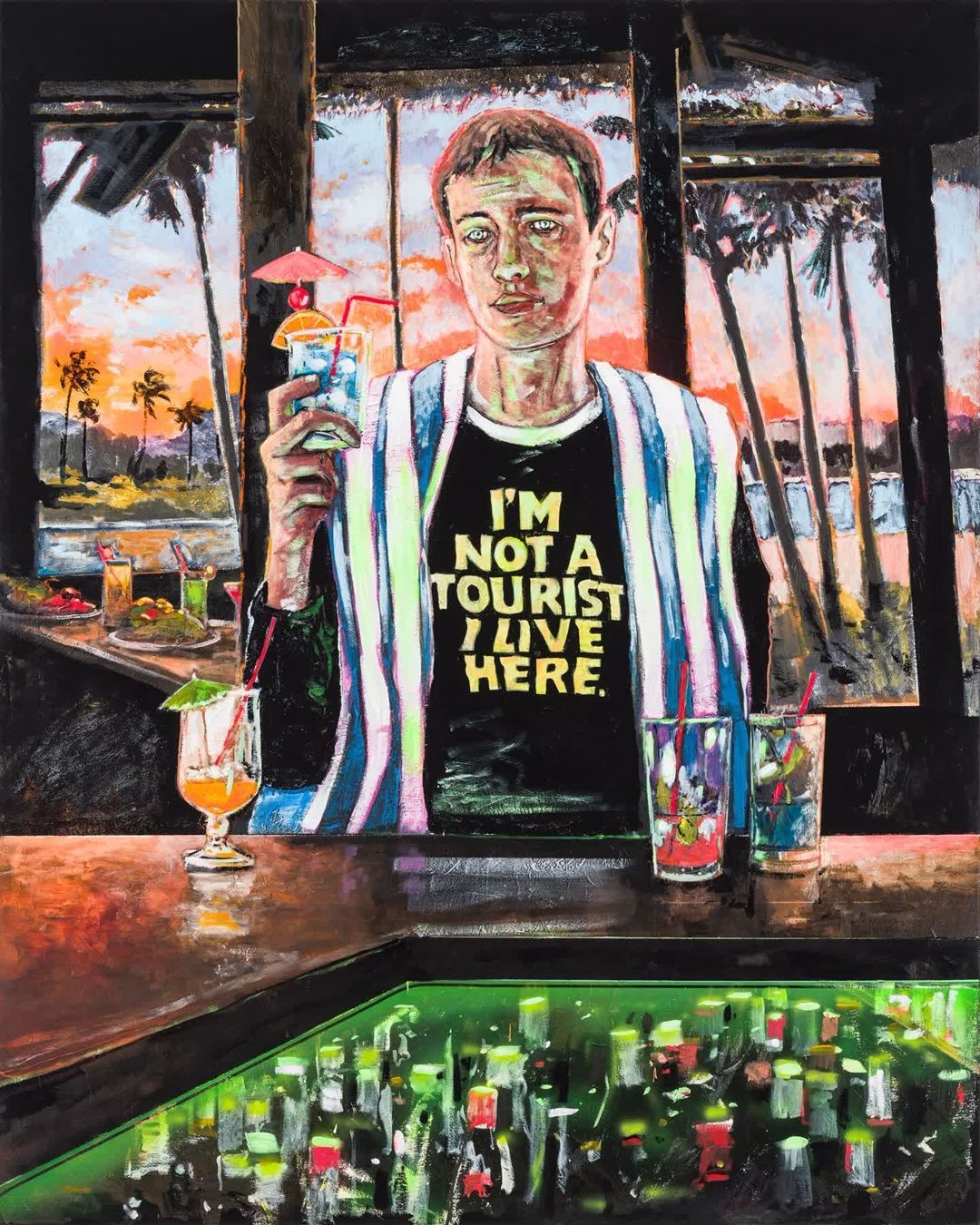
Hernan Bas arrives at Ca’ Pesaro with The Visitors, a perfect exhibition for a city devoured by tourism while continuing to sell its image. Bas works on the clichés of the contemporary traveller like an ironic and decadent entomologist, exploring dark tourism, Instagrammable places, spectacle-attractions, and sacredness transformed into experiential merchandising. In his paintings, tourists resemble disoriented ghosts suspended between authentic desire and compulsive consumption of experience. But Bas does not stop at sociological critique. His painting is also deeply seductive, theatrical, full of queer humour and romantic melancholy. Looking at these works, one has the sensation that contemporary tourism has become a form of collective sleepwalking. And Venice, naturally, is the perfect stage for this great global tragicomedy.
Title: Hernan Bas - The Visitors
When: from May 7 to August 30, 2026
Where: Ca’ Pesaro, Venice
Ai Weiwei – L’Aquila
Ai Weiwei’s exhibition Aftershock, running at MAXXI L’Aquila until September 6, could not have found a more symbolic setting. The dialogue between works created after the Sichuan earthquake and the still-physical memory of the L’Aquila earthquake generates an extraordinarily powerful emotional tension. The enormous installation Straight, built from steel rebars recovered from collapsed schools, almost resembles a form of material testimony. But the exhibition also traverses war, censorship, migration, propaganda, and memory. Ai Weiwei continues to use art as a political lever without renouncing visual spectacle. Perhaps the decisive point of his work lies precisely in his ability to speak about tragedy without turning it into rhetoric. Palazzo Ardinghelli, restored after the 2009 earthquake and serving as the exhibition venue, becomes an integral part of the experience, almost an architectural resonance chamber.
Title: Ai Weiwei – Aftershock
When: until September 6, 2026
Where: National Museum of 21st Century Arts, L’Aquila
La mostra Aftershock di Ai Weiwei, che si terrà al MAXXI L’Aquila fino al prossimo 6 settembre, non poteva trovare luogo più simbolico. Il dialogo tra le opere nate dopo il terremoto del Sichuan e la memoria ancora fisica del sisma aquilano produce una tensione emotiva potentissima. L’enorme installazione Straight, costruita con tondini d’acciaio recuperati dalle scuole crollate, sembra quasi una forma di testimonianza materiale. Ma la mostra attraversa anche guerra, censura, migrazioni, propaganda, memoria. Ai Weiwei continua a usare l’arte come leva politica senza rinunciare alla spettacolarità visiva. E forse il punto decisivo della sua ricerca è proprio il riuscire a parlare di tragedia senza trasformarla in retorica. Palazzo Ardinghelli, restaurato dopo il terremoto del 2009, location della mostra; ne diventa parte integrante, quasi una cassa di risonanza architettonica.
Benoit Maire – Rome
Federica Schiavo Gallery in Rome hosts Grunge by Benoît Maire, an exhibition that uses the aesthetics of neglect as a philosophical device. Through crooked paintings, rejected harmonies, and artworks left in corners like empty glasses after a 1990s party, Maire takes the concept of grunge and transforms it into a cultural category. It is a far more sophisticated operation than it initially appears. Behind the apparent randomness lies an extremely lucid reflection on the exhaustion of the West, on the impossibility of truly believing in the new, and on nostalgia as a form of symbolic burnout. Art, philosophy, mathematics, and psychoanalysis intertwine within a deliberately “dirty” installation that seems to convert disorder into a critical language.
Title: Benoit Maire – Grunge
When: from May 9 to July 25, 2026
Where: Federica Schiavo Gallery, Rome
Alessandro Mendini - Verbania
In Verbania, within the elegant setting of Villa Giulia, comes one of the most anticipated events for lovers of Italian design: Alessandro Mendini. Things. Rooms as Worlds. Mendini is presented room by room, almost as though each object were an autonomous planet. And that is exactly how his imagination functioned. From the Proust Armchair of 1978 to the Mendinigrafo of 1985, passing through Alessi and Radical Design, what emerges is an author who transformed design into emotional narration. Mendini did not want to create simple objects, but rather sentimental worlds. His great intuition was understanding that design could be ironic, literary, fragile, even autobiographical. Today, in the era of algorithmic minimalism and products designed to be photographed before they are even used, his decorative universe suddenly appears revolutionary.
Title: Alessandro Mendini. Things. Rooms as Worlds
When: from May 16 to September 27, 2026
Where: Villa Giulia, Verbania
Arthur Jafa and Richard Prince - Venice
If you are planning a trip to Venice, stop at Ca’ Corner della Regina, headquarters of the Fondazione Prada, which from May 9 to November 23, 2026 hosts Helter Skelter: Arthur Jafa and Richard Prince, one of the theoretically densest exhibitions of the season. Arthur Jafa and Richard Prince are placed in dialogue through appropriation, pop culture, ready-mades, and American obsessions. The result is a gigantic anatomy of the contemporary United States. Jafa works on Black culture and American racial memory; Prince dismantles white masculinity and the toxic myth of the American way of life. Both plunder images like visual pirates: YouTube, advertising, pulp fiction, rock music, and social media. The exhibition is fascinating precisely because it refuses any linear moralism. It does not judge America. It places it under strobe lighting, allowing its violence, irony, spirituality, and paranoia to emerge. In an age of compulsive image consumption, Helter Skelter is also a disturbing reflection on who truly owns the contemporary imagination.
Title: Helter Skelter: Arthur Jafa and Richard Prince
When: from May 9 to November 23, 2026
Where: Fondazione Prada, Venice
Miles Davis - Pordenone
Miles Davis 100 - Listen to This! brings to Villa Cattaneo in Pordenone an exhibition destined to become a site of musical pilgrimage. Miles Davis is celebrated on the centenary of his birth not as a mere jazz legend, but as permanent mutation. The most interesting thing is that the exhibition avoids the museum-like risk of becoming a celebratory holy card. Instead, Listen to This! constructs an immersive ecosystem made up of listening stations, archives, technology, vinyl records, photographs, fashion, cinema, Columbia Records documents, and above all music. A huge amount of music. The section dedicated to Bitches Brew promises to be a true sensory experience. And then there is him: Miles’s face, stern, elegant, alien. More than a musician, he appears as a cultural device that still generates the future today. Shall we bet that, if you are not already one, you will become a fan of Davis—or at least start listening to his records and losing yourself in his music?
Title: Miles Davis 100 - Listen to this!
When: from May 8 to July 12, 2026
Where: Villa Cattaneo, Pordenone