








































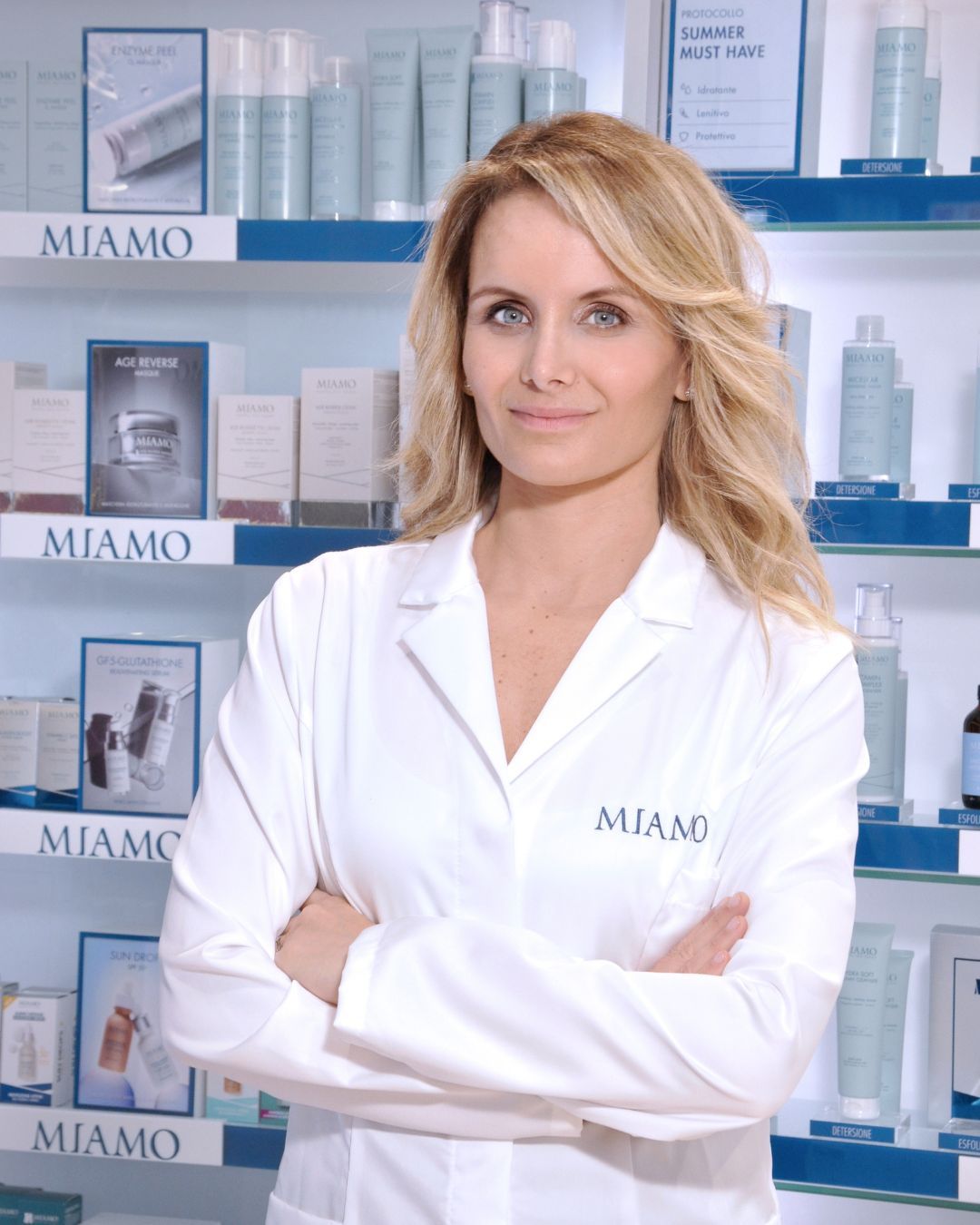
The serum layering technique works, word of Camilla D'Antonio Interview with the Scientific Director and Co-founder of Miamo
Information about skincare can sometimes be so overwhelming that it confuses us. What should we apply to our face during the day and what at night? What can we layer and what, if used incorrectly, could damage the skin barrier, causing irritation and sensitivity? What should we use in the morning and what in the evening? Should we carefully follow a 12-step routine, or is it better to stick to three or four steps and actually do them every single day? Is it all a matter of measure, a numbers game, a search for time we don’t have just to feel good about ourselves, take care of our skin, and avoid making mistakes? One thing to keep in mind: not all information carries the same weight. Camilla D'Antonio, Scientific Director and Co-Founder of Miamo, is here to debunk myths and explain how serum layering works. That is, the art of layering serums, key players in skincare, especially when used correctly and, crucially, in the right sequence.
Interview with Camilla D'Antonio, revealing the secrets of using facial serums
At a time when skinimalism promotes simplified routines, why did you choose to focus on serum layering as a differentiating approach?
Skinimalism stems from a valid need: to simplify and reduce excess. It mainly applies to those who do not suffer from specific skin concerns. Serum layering is not the opposite of simplification, but rather its conscious evolution, designed to address dermatological conditions that are unlikely to resolve with just one product. We don’t propose more products, but targeted protocols used strategically to achieve maximum benefits. Layering allows you to address different skin needs in a precise way, avoiding “all-in-one” formulas that often compromise concentration and effectiveness. A routine with two or three carefully selected serums can be more essential, and more effective, than a single generic product.
Can you explain how the sequence of serums affects the efficacy of active ingredients?
Sequence is essential because the skin is a biological system, not a passive surface. Applying a serum that works on hydration or barrier support first improves the skin’s receptivity to the active ingredients that follow. A typical example is using Hyaluronic 14+ Fusion Serum as the first step to optimize the absorption of a nourishing or anti-aging serum applied afterward. If the order is incorrect, even the most high-performing active ingredient may fail to reach its full potential.
How does Miamo study texture and ingredient compatibility to ensure optimal absorption while respecting skin physiology?
At Miamo, we always start from skin physiology: each formula is developed not only around the individual ingredient, but also around how it behaves on the skin and in synergy with other products. Texture, molecular weight of active ingredients, delivery systems, and absorption time are all tested to ensure each serum can fit into a modular routine. That’s why a serum like Essential Lipids Serum can be used alone or after a water-based serum to prevent transepidermal water loss without compromising absorption.
What scientific criteria guide the layering order of serums? Is it just about consistency, or also function and mechanism of action?
Consistency is only one factor. In reality, the order is primarily guided by function, mechanism of action, and biological objective. First, you work on hydration and barrier support, then on protection and stimulation. A serum like GF5 Glutathione Aox Boost Serum, for example, only makes sense if the skin is already balanced. Layering without considering the function of active ingredients reduces effectiveness and increases the risk of sensitivity. Serum layering is especially suitable for skin dealing with multiple concerns at the same time.
How do you build a personalized protocol?
When the skin presents multiple concerns, such as dehydration, loss of volume, and sensitivity—layering becomes a strategic tool. You always start with the primary need: often, that’s the barrier. In these cases, a protocol may include Hyaluronic 14+ Fusion Serum followed by Nourish 3 Biotic Rich Serum to restore a compromised barrier and nourish the tissues, and finally Essential Lipids Serum to seal in hydration and reduce the appearance of dehydration lines. The secret is not to treat everything at once, but to build a progressive response.
In a market where serums are often treated as miracle products, how does Miamo educate consumers on proper use?
Through scientific education and transparency. We explain that no serum works effectively if used incorrectly within a routine. For example, a high-concentration Vitamin C like Vitamin C 30% Serum is extremely effective, but it should not be layered carelessly or applied to unprepared skin. Educating means teaching when to use an active ingredient, how often, and most importantly, why.
What developments do you foresee for serum layering in the next 3–5 years?
I believe it will become increasingly personalized and guided, even for skin without obvious concerns. The future is not about using more products, but about using them better. Serum layering will become a kind of “cosmetic wardrobe,” where each serum has a precise function and is used only when needed.
Which Miamo serum combinations do you recommend, and for what concerns?
Some simple and functional examples: for loss of volume and hydration + restoration of a compromised skin barrier: Hyaluronic 14+ Fusion Serum + Nourish 3-Biotic Rich Serum. For loss of firmness + expression lines: Collagen Boost Intense Serum + Multi-Peptide 20% Lifting Serum. For hyperpigmentation and a compromised barrier with skin sensitivity: Pigment Control + Essential Lipids Serum. All essential routines, yet highly targeted.