




































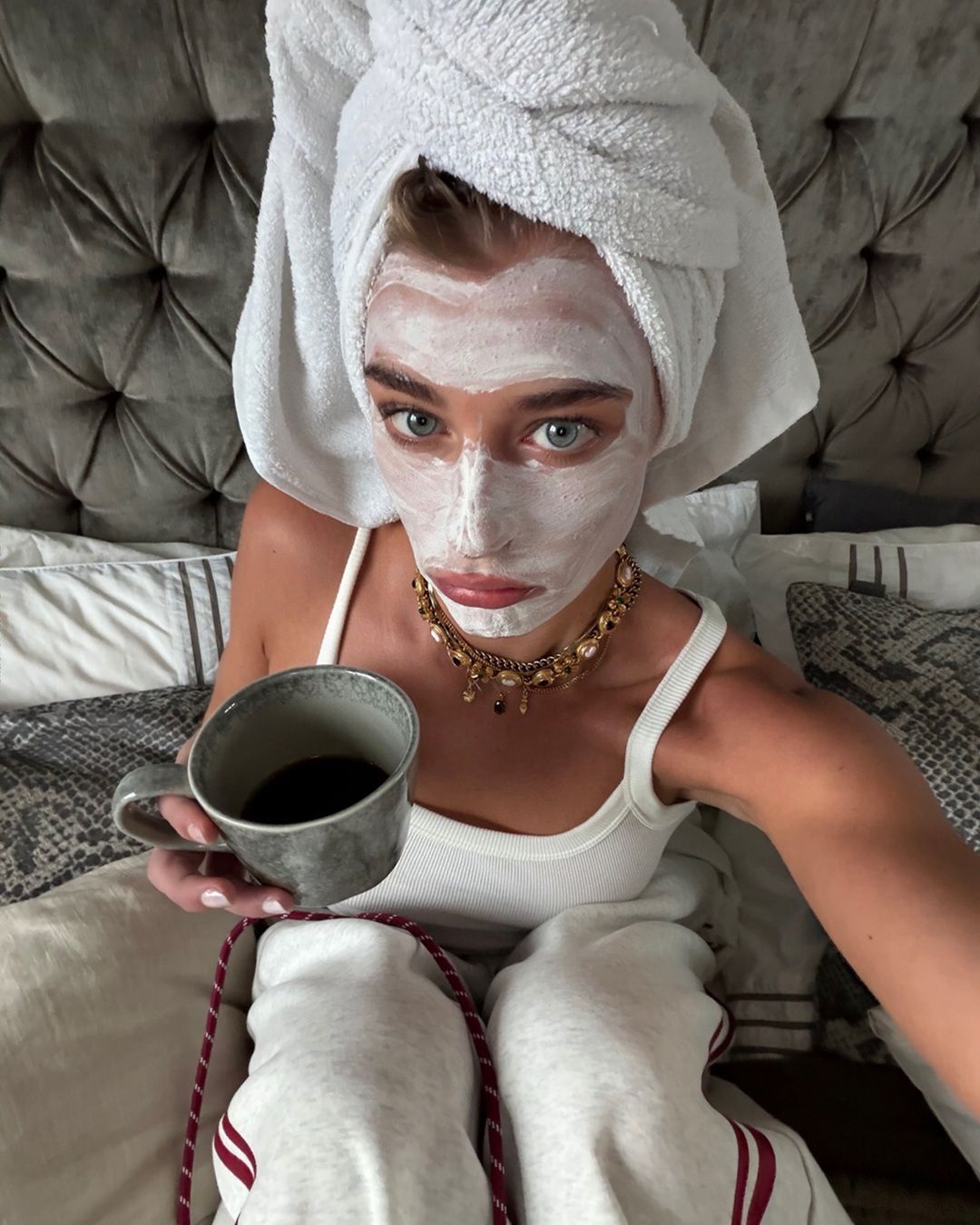
Skincare and the menstrual cycle: do we really need to change routines every week? Is there anything scientific behind this new obsession with the menstrual calendar?
There are days when we look in the mirror and our skin seems particularly collaborative. The foundation spreads well, we don't have particularly obvious imperfections and even that luminosity that we try to achieve with serums and highlighters seems to come on its own. Then there are the other days. Those where a pimple appears on the chin right before an appointment, the skin seems more sensitive than usual and we wonder what we did wrong with skincare. Maybe nothing, maybe my period is just coming. That the menstrual cycle can affect the skin is not a recent discovery. The news is the way in which we started to tell it, especially on social networks. On TikTok, cycle syncing, or the idea of adapting certain habits to the different phases of the cycle, has also arrived in front of the bathroom mirror. The result? Routines organized week by week, ingredients to be used on certain days and products that seem to have a fixed appointment with our calendar. Do we really need four different skincare to take care of the same face?
The skin changes during the cycle, but it doesn't follow a perfect calendar
Let's start with one important thing: hormones really affect the skin. The oscillations of estrogen and progesterone during the menstrual cycle can affect sebum production, hydration, barrier function and inflammatory response. This, however, does not mean that our face undergoes four perfectly recognizable transformations every month. As Ines Mordente, a surgeon specializing in Dermatology and Venereology, explains: “The skin is an organ sensitive to hormonal oscillations,” but skin changes are not universal or precisely predictable. In the follicular phase, when estrogen begins to increase, some people may notice more balanced and hydrated skin. During ovulation, these conditions may persist, although there is not enough evidence to support that this is necessarily the time when we are brightest. In the luteal phase, the one that precedes menstruation, hormonal changes can instead favor the appearance of imperfections in predisposed people. During menstruation, the drop in hormones may be accompanied by an increased feeling of dryness or sensitivity. The word to keep in mind, however, is may. Not all of us experience the same changes, not all of us get worse acne before our period, and not all of us wake up with wonderful skin during ovulation. In fact, Dr. Ines points out that the skin's response also depends on individual sensitivity to hormones, genetics, possible dermatological conditions and environmental factors. Even studies on cyclical changes in sebum, hydration and skin barrier do not always return consistent results. In short, the cycle can affect our face, but it will hardly agree to behave exactly as predicted by an infographic.
Four phases, four skincare: but who asked us?
At this point comes the question that really interests those who already have a full bathroom cabinet: do we have to buy different products for each phase of the cycle? According to the dermatologist, the answer is definitely less complicated than some tutorials suggest. “Skincare must adapt to the needs of the skin, not necessarily to the menstrual calendar,” explains Ines. The risk of cycle syncing applied to cosmetics is to transform normal physiological variability into four different routines, perhaps accompanied by as many purchases. Let's think about it: we've just learned that you don't necessarily need ten steps to have a good skincare and now we should organize four versions, one for each week? One dedicated to hydration, one to exfoliation, one to purifying active ingredients and maybe another to face the days of menstruation. It's a neat, easy-to-tell breakdown, and perfect for an Instagram carousel. It's a pity that, from a dermatological point of view, there is no solid evidence that demonstrates the superiority of this scheme over a personalized and continuous routine. The skin, first of all, needs consistency. Adequate cleansing, hydration and daily sun protection remain the basics, regardless of the day of the month. This doesn't mean ignoring what's going on in front of the mirror. If we notice that at certain times the skin becomes more sensitive, we can temporarily reduce exfoliants or potentially irritating active ingredients, giving preference to formulas with ceramides, glycerin and soothing ingredients. If, on the other hand, recurring imperfections appear, ingredients such as salicylic acid or azelaic acid may be useful, provided they are chosen based on individual needs and skin tolerability. The point, however, is not to confuse attention with the need to intervene continuously. Some dermatological treatments, such as topical retinoids used for acne, require continuity to work and should not be introduced and suspended arbitrarily depending on the week. Their choice must also take into account a possible pregnancy or its planning. Knowing your skin also means understanding when it is best to let what we are already using work.
A pimple before your period is not an inevitable appointment
Then there is an experience that many know all too well: that pimple that appears punctually in the days before menstruation, often in the same place, as if it had a reminder on the phone. Acne can actually worsen in the premenstrual phase, even when hormone levels are normal. Not only does the amount of hormones in the body matter, but also the way in which the sebaceous glands respond to their action. However, the dermatologist invites us to distinguish two situations: “It is important to distinguish the premenstrual worsening of an already present acne from the occasional appearance of some imperfections.” In the first case, we are talking about an inflammatory condition that requires a correct dermatological framework; in the second, targeted cosmetic measures may be sufficient. Not all pimples need the same response, just as not all blemished skin necessarily has acne. Above all, the pimple does not appear when we see it. Before it appears on the skin surface, the processes involving follicle obstruction and inflammation may have already started. This is why using a purifying product only three or four days before menstruation is not always sufficient to prevent its onset. When it comes to acne, prevention often requires ongoing treatments and, in more persistent or inflammatory cases, specific dermatological therapies. In some situations, it may also be appropriate to consider a hormonal approach with your doctor. Among the mistakes that Ines observes most frequently are the excessive use of exfoliants, aggressive cleansing in an attempt to eliminate sebum and the continuous change of products. All habits that risk compromising the skin barrier and increasing irritation and inflammation. In practice, in an attempt to anticipate every possible imperfection, we can end up complicating the situation even further.
We should learn to know the skin, not to chase it
There is something interesting in the way in which beauty manages to transform any aspect of our daily lives into a new routine. First we learned to recognize our skin type, then to identify the most suitable ingredients, to combine the active ingredients, to respect the skin barrier. Now the risk is to feel lagging behind even our hormones, as if we weren't doing enough if we haven't foreseen every possible facial change. Yet cycle syncing, net of the promises that circulate on social networks, can also leave us a useful starting point: to observe our skin over time. Notice if some imperfections appear regularly before menstruation, if on certain days we feel more dry or if the sensitivity changes. Not to automatically build a calendar of products, but to recognize any recurrences and understand when it is useful to adapt something or seek the advice of a specialist. Ines Mordente sums it up with a consideration that deserves to be shared: “We must not teach women to chase every hormonal fluctuation with a new cosmetic product. We need to teach them to know their skin.” This is precisely the part of the trend that is worth keeping. We can pay attention to the changes in our body without turning them all into problems to be solved, accepting that the skin is not identical every day and that not everything requires a new purchase. The menstrual cycle can affect our skin, but it doesn't necessarily have to organize the bathroom cabinet as well. What if the best skincare was simply the one that works for us, any day of the month?
What to read next
The Manual Lift RT Method is the new pre-makeup routine you need to know about
Rosalia Tuttobene's customized treatment focuses on contours, tension, and texture to create a more relaxed face that's ready for makeup
Rose PDRN is the beauty ingredient of the moment
For repairing the skin, reducing redness and boosting radiance

We have officially entered the soft face era
How natural beauty has become our new aesthetic priority