









































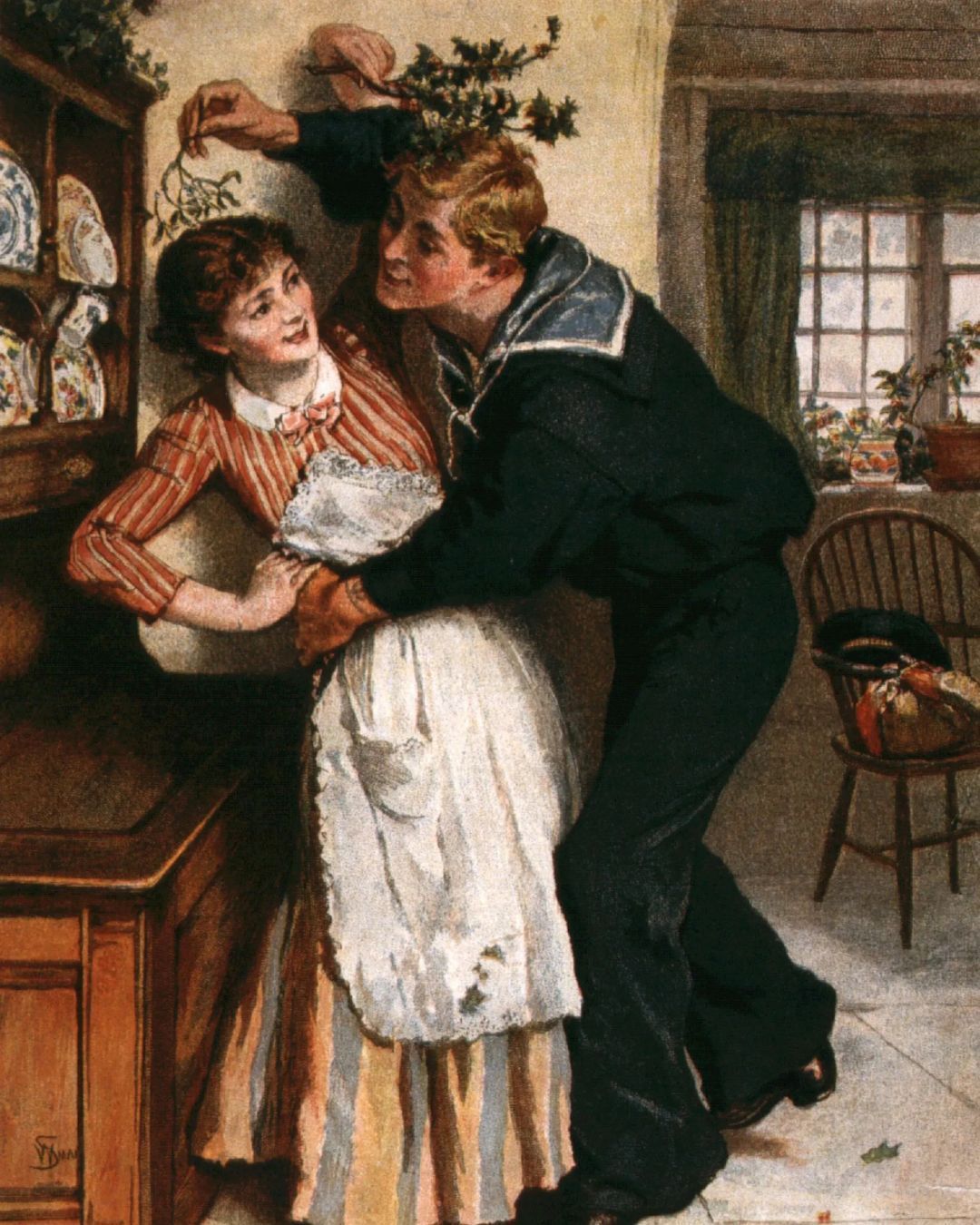
Kisses under the mistletoe, between oppression and freedom Have you ever wondered about the implications and meaning of a traditional gesture?
You know that Christmas movie, English or American, that children’s cartoon full of warm feelings, that story in which everything revolves around accidentally ending up under the mistletoe with the person you like, just to steal a kiss? This tradition has very ancient roots, especially in Anglo-Saxon countries, even though it’s not particularly widespread in Italy. As reported by Jezebel, the sacred nature of mistletoe is well documented by scholars of Celtic and Norse mythologies, where it was linked to special ceremonies. The Druids, for instance, harvested it for fertility rituals. Its transformation into a symbol of Christmas romance came later, along with all the consequences that followed, especially for women.
Where does the tradition of kissing under the mistletoe come from?
As explained by historian Ronald Hutton of the University of Bristol, in 18th-century England mistletoe became far more common in London’s Christmas markets. It had once been rare and difficult to find. Once commercialised, it made its way into English homes as part of Christmas decorations, alongside holly and ivy. Owning it was a status symbol. The custom of the kiss under the mistletoe was born in these homes, among servants, as a form of entertainment. When the masters of the house discovered it, they adopted the tradition themselves.
Born as a game, the kiss under the mistletoe became a certainty, a pretext, and even a narrative device. The outcomes were not always positive, especially for women and less powerful social groups. We are told as much, even if we might have guessed it, by Charles Dickens, who in the Christmas chapter of The Pickwick Papers describes how mistletoe had already become a source of fear for young women, servants and otherwise, who would run away to avoid a kiss perceived as obligatory. Adult women, instead, endured it out of politeness, social pressure, and fear of the consequences of refusal. From 1836 to 2017, little seems to have changed, as evidenced by a post from the Irish police department, which issued a warning eight years ago: “If you find yourself under the mistletoe with someone special tonight, remember: without consent, it’s rape.”
Kisses and mistletoe: between consent and feminism
As one might easily imagine, for a long time consent did not exist under the mistletoe. Kisses exchanged beneath this seemingly innocent sprig were almost always “stolen,” and all signs suggest that historically someone took advantage of the tradition to absolve themselves of responsibility and shame, in the name of custom. On the other hand, mistletoe may also have influenced the way desire and intimacy were understood at the threshold of modernity. Fear, embarrassment, amusement: all of these impulses coexisted in a kiss under the mistletoe, which could also serve as a way to normalise and release a hidden urge, overturning the coercive nature of the tradition, especially if one managed to find the perfect moment to stand beneath it with someone they truly wanted to kiss.
This is certainly not about dismantling centuries-old customs. Reflecting on mistletoe specifically, and on Christmas traditions more broadly, allows us to dig deeper in order to update and rediscover them, to make them better, and to be more aware of who we are and who we have been, with all our contradictions and complexity.