









































The great gender gap also exists in the art market The Frida Kahlo case highlights a clear but ignored problem
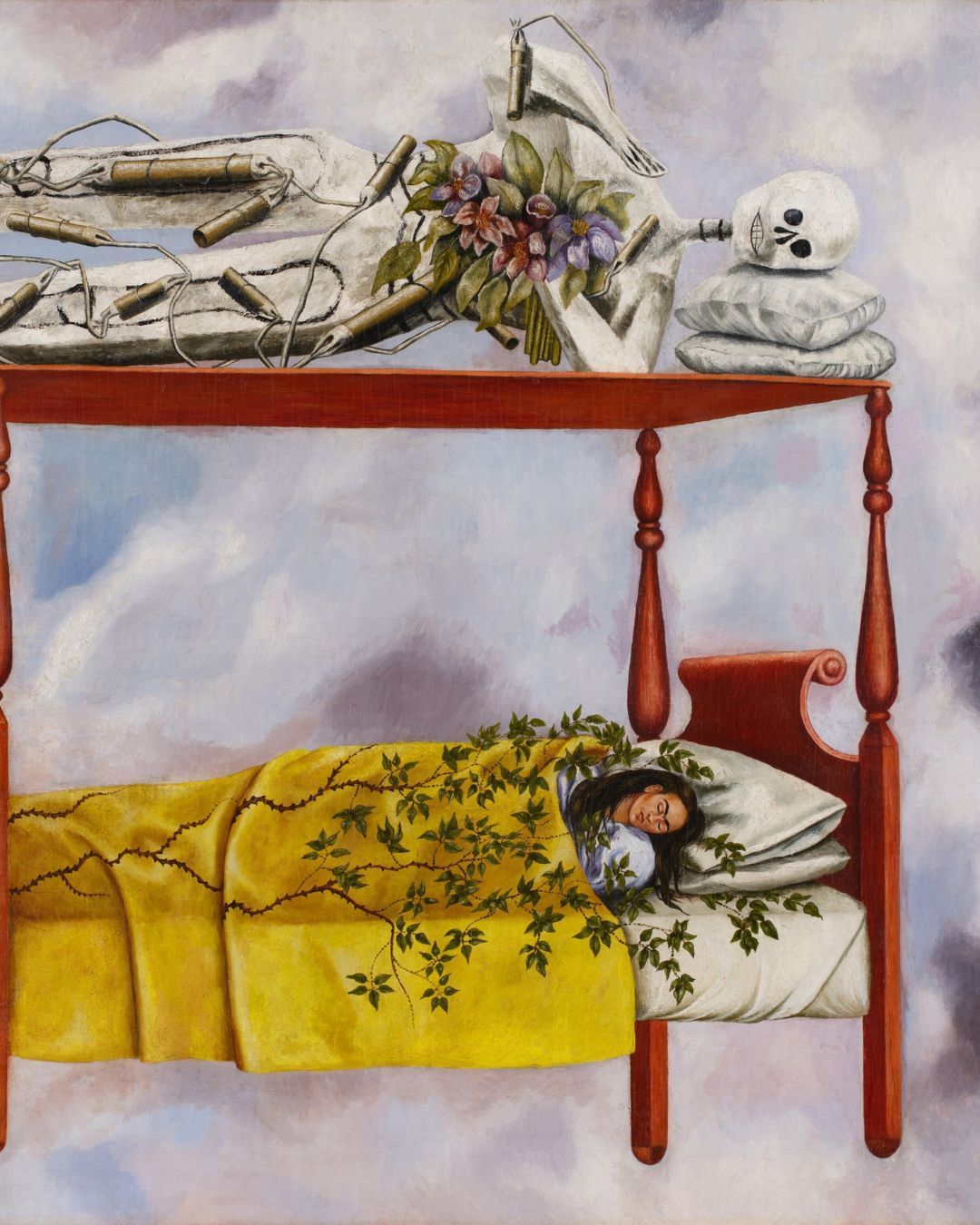
A self-portrait by Frida Kahlo has set a new milestone in the art market: her El sueño (La cama) has been sold for 54.7 million dollars. The figure, reached in just a few minutes during a Sotheby’s auction in New York, represents not only the new record for a work by the artist, but also the highest price ever for a female painter. In the record-breaking painting, created in 1940, Kahlo portrays herself sleeping in a bed, above which a smiling skeleton wrapped in dynamite appears on the canopy. Even in the face of evaluations exceeding 40 or 50 million dollars, the paradox remains evident: in the global art market, these female records still represent only a fraction of the value achieved by their male counterparts. The gap is so striking that it becomes clear this is not merely a matter of market taste, but a deeply rooted cultural and social system.
Female records that remain exceptions: Frida Kahlo and the gender gap in the contemporary art market
Despite these milestones, which may seem like signs of a turning point, the reality is different. In recent years, several sensational results, such as the figures reached by works by Georgia O’Keeffe, Frida Kahlo, or Jenny Saville, have been hailed as indicators of an ongoing shift. But it only takes a simple comparison with male records to reveal the imbalance: if a female icon can reach 50 million, a Caravaggio can soar beyond 450 million; if a living artist like Marlene Dumas caps at 13 or 14 million, Jeff Koons exceeds 90. This gap does not concern only the top tier of the market, it is replicated and amplified across mid-range segments and emerging careers. And it is precisely there that we see the root of the problem.
The art market: a system built by men
This gap cannot be explained solely through market dynamics. There are factors that run deeper, almost invisible. A 2021 study led by Renée B. Adams, professor of economics at the University of Oxford, showed that two identical works, digitally signed with a male or female name, are judged differently by regular collectors: those attributed to a male artist consistently receive higher evaluations. This is not explicit bias, but a deeply ingrained cultural automatism, fuelled by the way art has been narrated, studied, and transmitted for centuries. Experts who study how the art market functions agree: the economic value of a work depends not only on its artistic quality, but above all on how society perceives its creator.
Exceptions do not change the whole
This imbalance is far from new. Research shows that in the 1990s, there were many more women artists on the secondary market—even if at lower prices; today, attention focuses only on a few star women, while the rest remain invisible. It is as if the climb to the top has become steeper and only very few artists manage to emerge and gain recognition. The permanent collections of the world’s major museums are composed of over 90% works by men. It is a vicious circle that affects the entire ecosystem: curators, critics, art historians, museum directors, roles that, for a very long time, have been occupied predominantly by men and have built a canon that today appears distorted.
The change we claim
It is a vicious cycle that concerns the entire ecosystem. But something is, slowly, beginning to change. In the United States, the National Museum of Women in the Arts, and in Europe, collections such as that of Murray Edwards College, are working to correct course by expanding the presence of women artists and showcasing works that history has traditionally overlooked. These initiatives are slowly undermining the still widespread idea that true artistic genius is male and that female artists represent exceptions subordinate to a canon that remains to be rewritten. New generations of art historians are reassessing the canon, museums are adopting more equality-oriented policies, and the public—especially younger audiences—is showing growing sensitivity toward diversity and inclusion. It may take years, perhaps decades. But the direction is set, and the change, slow but steady, now appears irreversible.
