




























Who is Bhavitha Mandava? Everything we know about the first Indian model to open a Chanel fashion show
There are stories that seem as if they were written by a particularly ironic screenwriter, the kind who enjoys letting destiny collide with the banality of everyday life. In the case of Bhavitha Mandava, the stage was not a gilded salon in Paris but a New York subway station, a place where the city moves to the rhythm of hurried footsteps, earbuds in, and takeaway coffee in hand. Not a crowded casting room full of creative directors, but a noisy platform where students, commuters, and slightly weary dreams wait for the next train. It was there that fashion, the real kind, unpredictable, almost novelistic, decided to intervene. In less than two years, an Indian student who arrived in the United States with two suitcases and a university loan became one of the most talked-about faces in the fashion system, eventually making history as the first Indian model to open a Chanel show. The beauty of the story is that it doesn’t feel staged. It has the structure of a modern parable, built on coincidences, hard work, and a certain dose of narrative irony. Because the very subway that once saw her rushing between classes has, almost symbolically, become the stage of her triumph.
When destiny takes the subway
Before her name began circulating among editorial offices, casting directors, and social networks, Bhavitha Mandava had imagined a very different trajectory for herself. Born in Vijayawada and raised in Hyderabad, in southern India, she followed a rigorous and almost traditional academic path typical of a middle-class family: study hard, build a solid career, and find a stable job. Her first step was a degree in architecture from the Jawaharlal Nehru Technological University in Hyderabad, an environment where design, engineering, and creative vision intersect. But Mandava did not stop there. Like many talented young people of her generation, she decided to look beyond national borders and move to New York to continue her studies. At New York University she enrolled in a Master of Science in Integrated Design & Media, specializing in Human-Computer Interaction, a sophisticated field that explores the relationship between technology and human behavior. It is not the typical résumé of a future model. In fact, it is almost the opposite. Mandava described herself on LinkedIn as a product designer passionate about emerging technologies and how they can improve human experience. At NYU she also worked as a communications specialist at the MakerSpace, the university’s prototyping lab where students and researchers experiment with 3D printing, digital design, and new materials. Her life was made up of classes, campus work shifts, university projects, and long subway rides between Brooklyn and Manhattan. It was the typical routine of an international student, stimulating, frenetic, and often financially challenging. The big goal? Quite simple: graduate, find a job in the tech sector, and repay a considerable student loan. Fashion, up to that moment, was only a remote possibility. Yet that very student debt, which seemed like a burden, would become the decisive detail in the story.
From master’s degree to runway: the birth of a model
The turning point arrives in the summer of 2024. An ordinary day, a subway platform at Atlantic Avenue in Brooklyn. Mandava is waiting for the train when she is approached by Showin Bishop, founder of the agency 28Models. It is a scene that seems lifted straight from a 1990s fashion film, with a scout spotting something magnetic in a stranger. Bishop suggests she consider a modeling career. Mandava refuses. It is not in her plans, not her world. But they keep talking. When he mentions the real possibility of earning enough to repay her student loan, the perspective changes. The “no” becomes a “maybe.” Then it becomes “okay, let’s try.” Her photos are sent to the legendary casting director Anita Bitton, a key figure in the industry known for opening fashion to talents from diverse cultural backgrounds. Bitton shows them to Matthieu Blazy, then the creative director of Bottega Veneta. Blazy’s response is immediate. He sees something special in the girl who until a few days earlier had been working in a university lab. Just two weeks after being discovered, Bhavitha Mandava makes her runway debut at Bottega Veneta’s Spring/Summer 2025 show. The look is deliberately minimal: an oversized white shirt over a pleated skirt, snakeskin-print sandals, and a yellow bag. An outfit that emphasizes the naturalness of her presence. The surprising thing is the confidence with which she walks the runway. She is elegant, focused, almost unaware of the importance of the moment. Soon other prestigious shows follow, including Dior and Courrèges. Yet while her name begins circulating in international fashion, Mandava continues to live an almost surreal double life: during the day she worked at the NYU MakerSpace, in the evening she attended classes, at night she did her assignments, and on weekends she flew to Europe to walk in fashion shows. A rhythm that would exhaust anyone. And yet she never abandoned her main goal of completing her academic path. In May 2025 she graduates from NYU with her master’s degree in hand and, as she wrote herself, “a heart full of gratitude.”
The first Indian model to open a Chanel show
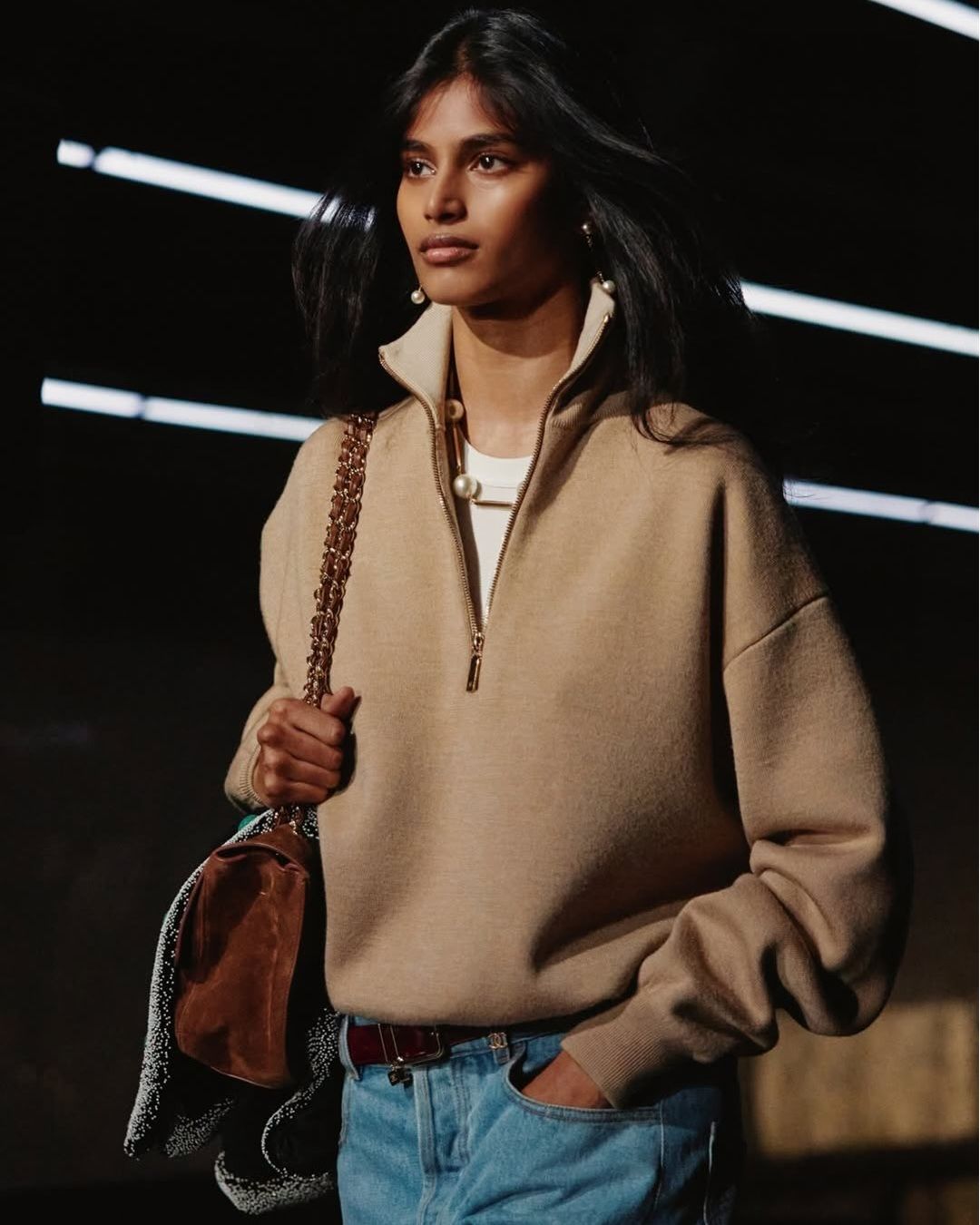
The real turning point arrives when Matthieu Blazy is appointed artistic director of Chanel in 2024. And, as often happens in fashion history, the designer brings some of his creative muses with him. Among them is, of course, Bhavitha Mandava. Her runway debut for Chanel comes with the SS26 show. The look? A black dress decorated with golden tassels and pink feathers along the hem. It marks the beginning of a collaboration destined to grow rapidly. In December of the same year, 2025, Blazy decides to have Mandava open the Métiers d’Art 2026 show. In doing so, Mandava becomes the first Indian model in history to open a Chanel show. The location is an abandoned subway station in New York, the Bowery Station. The narrative short circuit is perfect. Imagine: the girl discovered in the subway opens a Chanel show… in the subway. The look chosen for her is deliberately simple: a beige zip-up sweatshirt, blue jeans, white shoes with black tips, and a roomy bag. The urban uniform of a student rushing between classes. Almost a tribute to the Bhavitha of a year earlier. A few hours after the show, the model posts on social media a video of her parents watching the show from India, her mother applauding and repeating her name with pride. The internet, predictably, goes wild. The clip becomes viral and transforms that moment into something that goes beyond fashion. It becomes a story about migration, family, and dreams coming true. But the definitive consecration arrives shortly afterward with the Spring/Summer 2026 Haute Couture show, during which Mandava closes the runway as the Chanel bride, one of the most symbolic roles in the entire couture ritual. A couple of months later, the iconic French house names the twenty-six-year-old a House Ambassador of Chanel, once again the first Indian woman to hold the role. Mandava thus joins an exclusive group of global superstars such as Margot Robbie and Jennie Kim.
Bhavitha and Matthieu Blazy’s new vision for Chanel
The choice of Bhavitha Mandava is not accidental. It is perfectly aligned with Matthieu Blazy’s new vision for Chanel, which is gradually redefining the identity of the house by shifting it toward a more contemporary femininity, less ritualistic and more everyday. His Chanel is not merely a temple of luxury but a laboratory of urban realities, diverse cultures, and authentic personal stories. The Belgian designer is known for his “everyday aesthetic,” an approach that transforms ordinary gestures and objects into elements of conceptual refinement. In his collections, luxury is never shouted; it is suggested through proportions, materials, and details. In this context, Mandava becomes the perfect embodiment of the new Chanel girl. Not a distant or aristocratic figure, but a cosmopolitan woman who takes the subway, studies, works, and builds her future. A woman who embodies the social and cultural mobility of our time. The show in the New York subway was interpreted by some as urban realism. In reality, as Blazy explained, it is almost cinema. A tribute to Coco Chanel’s first trip to the United States in 1931, when she discovered with surprise that American women wore her clothes naturally in everyday life. Mandava, with her mix of academic intelligence and spontaneity, perfectly represents this vision. She embodies what fashion can become when it stops looking only at the past and begins truly observing the present.
A new icon for global fashion
Within just a few months, Bhavitha Mandava has gone from being an almost anonymous student to one of the most interesting figures of the new generation of models. The year 2026 has only just begun, yet she has already appeared on the covers of magazines such as Numéro, Perfect, Double Vision, and British Vogue, culminating with the cover of i-D photographed by Inez and Vinoodh. A pace that, in the world of fashion, amounts to instant consecration. Yet what stands out most is not the speed of her rise, but the way she experiences it. Mandava maintains a disarming sense of irony. On social media she jokes that Chanel fulfilled her parents’ dream of seeing her married… even if, for now, the groom is only a couture look. She speaks openly about her origins, her studies, and her life as a student. In an industry that often constructs distant, flawless personas, her spontaneity is almost revolutionary. That is why it is hard not to root for her. Because Bhavitha Mandava does not represent just a new star in fashion. She represents a broader story, that of a global, mobile, highly educated, and culturally hybrid generation that is also changing the aesthetics of luxury. And if fashion loves symbols, this is one of the most fairy-tale-like of recent years: a girl who once took the subway to go to class… and who today has turned it into a runway.