

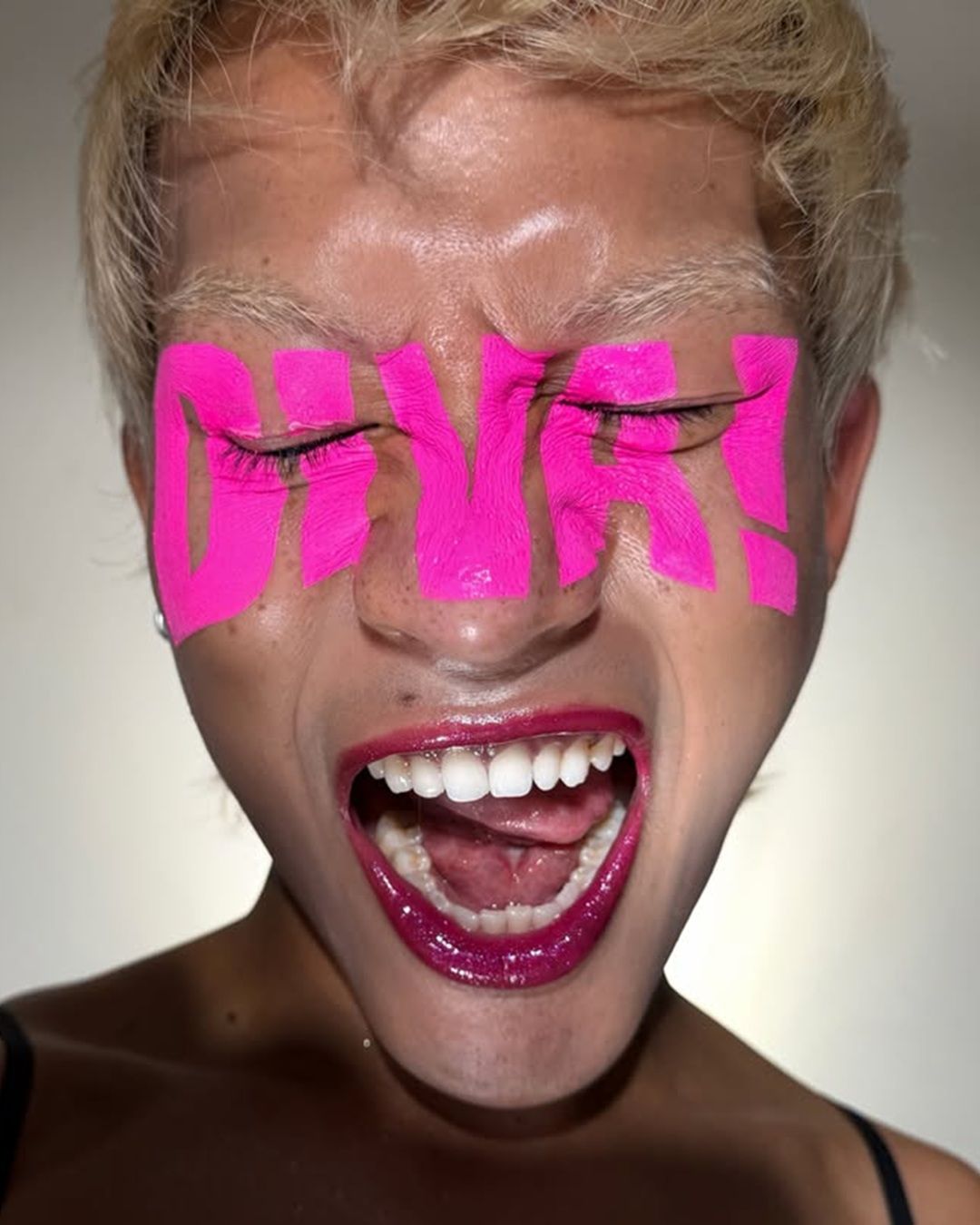
Makeup has something to say A new generation of creators is choosing makeup slogans to express their identity, dissent, and marketing
What if, instead of choosing between graphic eyeliner and bold lips, today’s entire beauty look came down to a single word? LUCKY, DIVA, VIRAL, or even FUCK SWAG. In the realm of slogan make-up, the face turns into a readable page, complete with oversized lettering, vintage Tumblr typography, and phrases that look pulled straight from a meme. Here, make-up goes beyond experimenting with shades and silhouettes to place language right at the center of the aesthetic. Sometimes a single lilac word across the forehead is all it takes to turn a face into an editorial moment, the kind that makes you stop scrolling your For You Page just to figure out if you're looking at make-up, graphic design, or a filter you haven't downloaded yet. Leading the charge is creator August, who has been playing with horoscope-inspired lettering and bold statements since 2024. Their lilac LUCKY look racked up millions of views, while Vlada Krukovskaya leans into provocative taglines and fonts reminiscent of fashion logos. Meanwhile, creators like Shiyao Miya, Thirza King, and Samhita Sharma channel the same concept through graphic calligraphy, glitter, and punchy hues. Change the typeface, switch up the message, and you instantly step into a new persona. Choosing a word means engineering an identity, if only for the duration of a selfie. But once a phrase catches millions of eyes, creativity quickly ceases to be just a personal affair.
From the feed to the campaign: the face as ad space
When a forehead tagline amasses millions of impressions, it’s safe to assume brand marketing teams have already opened Pinterest to take notes. Slogan make-up has every ingredient needed to become the next playground for beauty marketing, from logos painted across cheekbones and custom lettering tailored for product launches to creators doubling as walking, talking billboards with verified Instagram profiles. Unsurprisingly, Krukovskaya revealed to Dazed that she has already been approached by brands keen on partnerships. After all, a painted face cuts through the noise, sparks curiosity, and easily lands on Stories without giving off the vibe of a calculated ad campaign. Yet the downsides are just as real. When corporate briefs overwrite organic spontaneity, even the edgiest quip risks turning into a commercial stunt dressed up in trendy typography. The line between self-expression and commercial promotion becomes so thin that audiences can hardly tell where one ends and the other begins. The other potential issue? A trend that started as playful experimentation with creative make-up might end up turning every square inch of skin into monetizable prime real estate.
When beauty looks take a stance
A word across the face can do far more than sell lipstick: it can voice convictions, channel dissent, and carve out space for beauty activism. As Dazed points out, slogan tees proved long ago that getting dressed can be an act of political positioning. From Katharine Hamnett splashing radical slogans across T-shirts in the 1980s and Henry Holland’s tongue-in-cheek rhymes to Conner Ives's Protect the Dolls, fashion has consistently harnessed words to elevate clothing into a manifesto. Slogan make-up imports this exact mechanic onto the face, lending the statement an even more intimate, immediate punch. This convergence of beauty and politics is already catching academic interest. In Makeup Activism on TikTok, Laura Cervi and Verena Straub break down videos tied to the #WomanLifeFreedom and #NiUnaMenos movements, illustrating how tutorials and routine beauty formats can serve as viable vehicles for feminist mobilization and political messaging. The logic is straightforward: content calibrated to TikTok’s algorithmic rhythm can reach demographics that wouldn't normally seek out political discourse. In this context, beauty as a communication tool serves as an entry point for discussions on rights, systemic violence, and inequality, all without having to sound like a soapbox rally. This doesn't mean every painted motto is inherently revolutionary, nor does it guarantee viral traction translates to offline impact. What it does show, however, is that a visual code rooted in consumer culture can be repurposed to spotlight lived realities and systemic tensions that the algorithmic feed often compartmentalizes.
From the forehead to the streets
Meanwhile, outside the For You Page, Europe has plenty to voice. Across France, Spain, and Italy, the soaring cost of living, the housing crisis, and pervasive job insecurity are fueling diverse social protests, all united by demands for sustainable conditions. Against this backdrop, slogan make-up could well transition from intimate selfie culture to the collective energy of the streets. While it isn't an established emblem on picket lines just yet, imagining phrases like Housing is not a privilege or La vida no es un lujo illustrates how smoothly the format lends itself to grassroots activism. Words written on skin are easily photographed, replicated, and carried from the rally onto social platforms, reaching communities far beyond the immediate crowd. The beauty look becomes a distribution channel in its own right. The catch? Social movements risk being watered down into aestheticized snapshots, packaged for quick likes and discarded at the turn of the next trend cycle. To avoid that trap, the text must stay tethered to something tangible beyond the frame, a concrete demand, a community, a real struggle. Social media visibility can amplify a movement, but it cannot stand in for active participation. Not every face adorned with lettering is a manifesto, just as not every pop of color constitutes a political act. Yet when words are chosen deliberately to be seen, make-up stops being mere surface polish and carves out a platform to decide what to put on display, what to push back against, and which conversations to enter.
What to read next

10 horror divas to steal your look (and a few bad habits) for Halloween 2026
From the Gothic witch to the punk bride