












































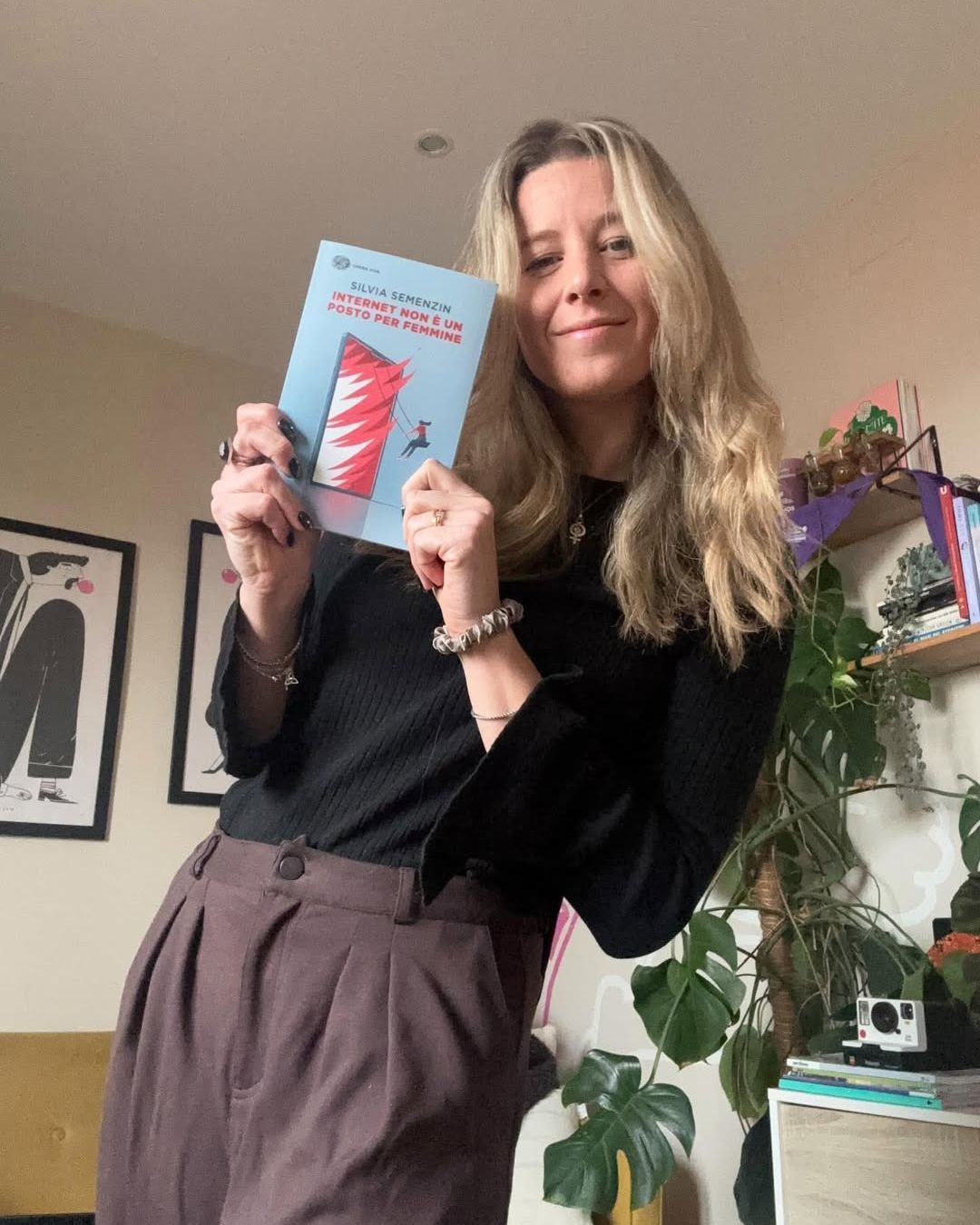
Is it true that the internet is not a place for women? Interview with Silvia Semenzin
The Internet is often portrayed as a neutral space, open and even democratic, a place full of possibilities. But for many women, and especially for those who speak out, show their bodies, or express dissent, the web is far from free. It is rife with violence, silencing, threats, and sexism disguised as humor or memes, and the line between entertainment and aggression is becoming increasingly blurred. In her new book Internet is Not a Safe Place for Women, activist and researcher Silvia Semenzin dismantles the comforting narrative that digital spaces are merely mirrors of society, showing instead that they are also structural amplifiers of its inequalities. We asked her a few questions to understand the political core of her work: what kind of Internet do we really want, and who should take responsibility for making it a free, safe, and feminist space?
Interview with Silvia Semenzin, author of "Internet is Not a Safe Place for Women"
In your book, you show how patriarchy today manifests even through memes, trends, and mainstream aesthetics. Why is it important to take these light forms of digital sexism seriously, instead of dismissing them as marginal or harmless?
What I highlight in the book is how digital narratives and the discourses coded into social media algorithms—which we use following the very rules that govern these tools are responsible for creating misogynistic imaginaries and scenarios. It is a mistake to think that the manosphere is a niche environment or an exception: on the contrary, it is the engine through which sexist discourses spread, which, even in their softer forms, become more socially acceptable, even among those who are not radicalized. In the chapter on online masculinity, I trace a line between the most extreme forms of male radicalization and the more invisible ones, propagated by YouTubers, influencers, and podcasters who, even without engaging in politics, reproduce discourses about men, portraying women as different from men and transmitting dangerous and stereotypical images.
Living in Spain, what differences do you see in how online gender-based violence is recognized and addressed compared to Italy? Does the legal framework matter more, or the cultural climate?
There are many differences with Spain in this regard. From an institutional perspective, Spain is light-years ahead of us. For example, this past November 25, they officially recognized digital gender-based violence as part of state prevention measures. In Catalonia, where I live, the regional government even launched a publicly funded platform the same day, offering victims free psychological, legal, and technical support to request removal of online content and report different forms of violence, such as stalking, deepfakes, hate speech, and more. In Spain, the institutions take responsibility for this, whereas in Italy, feminist associations - often under attack - shoulder these responsibilities. There is also the fact that feminism has taken deeper root culturally in Spain: it is taught in schools, women have more presence in the workforce, and the public discourse is more cohesive. When a woman is attacked, there is a collective response.
Algorithms learn from data imbued with stereotypes but are still presented as neutral tools. In your view, who really has the power to intervene in this fictitious neutrality: the platforms or policymakers?
For many years, digital feminism has shown how platforms are not neutral, for example by highlighting how violence and hate disproportionately affect already marginalized groups. Talking about digital rights without including feminism remains somewhat vague. Naturally, platforms and big tech have every incentive to convince people that algorithms are neutral, purely mathematical, and that no one is responsible for the outputs generated. For me, this is first and foremost a political issue, both institutionally and through activism: it is crucial to put the reclamation of digital spaces as non-commercial arenas at the center of progressive social agendas, so that democracy can flourish instead of withering as it does today.
Between revenge porn and sexual deepfakes, women’s bodies remain the main battlefield of technology. Is there something that seems more dangerous today compared to the past, or something that has finally improved?
After years in which feminism achieved a series of small victories even regarding online violence, today we are witnessing a resurgence of an anti-feminist movement, with powerful actors using technology to serve misogyny. There is a real censorship of these discussions: even sex-education initiatives and other programs are increasingly obscured. From a user perspective, one worrying phenomenon I am researching is that men who previously committed violence in a context of trivialization now claim their violence as legitimate, as a right. This makes violence increasingly organized and prevalent, as in the case of deepfakes. In practice, simply existing as a woman makes you a target online. What I hope is that the feminist voice unites: we are in a moment of great difficulty, but my final call in the book is directed to diverse voices, maintaining the capacity to network, a capacity unfortunately exercised better by the right than by the left or feminism itself.
If you had to summarize the core of the book in a clear political message: what kind of Internet do we want, and who is responsible for making it truly free, safe, and feminist?
The core message of the book is that the Internet is not yet a safe place for women, but it can become one if we use feminism as a pen to rewrite the web with new rules. The Internet belongs to us. It is essential to put back at the center of the political agenda the need to reclaim tools to build a new vision of society and the Internet. Together, we can create an alternative to rampant hate.
