

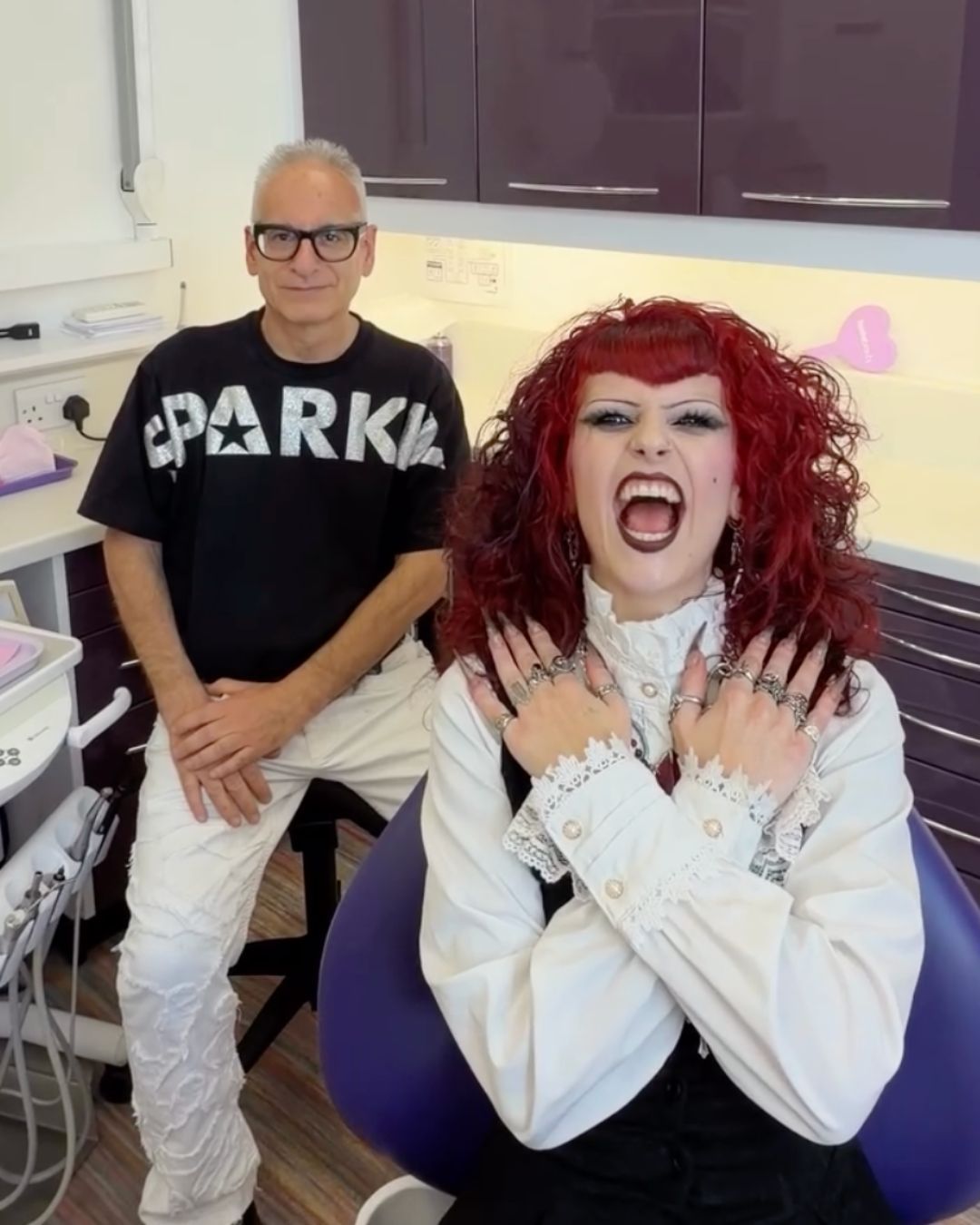
Vampire fangs are not only for Halloween What drives someone to alter their smile to look like a fictional creature?
Dressing up as a vampire for Halloween - let's be real - has always screamed a bit cliché. A black cape, plastic fangs, a swipe of red lipstick: minimal effort, job done. But what if we chose to look like a vampire every single day? Some people are doing just that, altering their teeth to give themselves permanently pointed canines, just like a flesh-and-blood vampire (if they actually existed, of course). Across social platforms, this aesthetic choice is pulling serious traction, riding the wave between gothic subcultures and body modification. Yet it also raises a genuine question: why choose to make a trait traditionally confined to the realm of fiction permanent, or at least long-lasting?
Vampires in pop culture, way beyond Halloween
The vampire has undergone quite the evolution in collective pop culture. Once a menacing, monstrous figure, it has morphed into a seductive icon embodying allure and rebellion. From Twilight to The Vampire Diaries, the aesthetic retains an undeniable grip, stretching far past October 31st costume parties. Pointed canines aren't entirely new to the body modification scene either. Back in 2019, Dazed spotlighted a woman who chose to file down her natural teeth into sharp fangs. Today, the movement has blown up, a quick search for vampire fangs on TikTok confirms it, partly thanks to far less invasive, long-lasting yet fully reversible procedures.
Philosofay's new fangs
For Philosofay, a UK-based creator boasting over 600,000 followers across Instagram and TikTok, the vampire obsession dates back to her teenage years. "I remember being thirteen and completely obsessed with the Twilight books. It made me genuinely sad that I couldn't actually become a vampire. I always related to Bella in that way," she shares. To this day, her personal style and beauty moodboards lean heavily into romantic gothic aesthetics - she even dropped a vampiric beauty collaboration with Glisten Cosmetics, aptly named Cold Blooded. The decision to sculpt her canines into fangs came after meeting a friend who had already taken the plunge. She was the one who introduced her to composite bonding, a dental technique that reshapes teeth through the application of composite resin. Following a few months of second-guessing, mostly fueled by the fear of outside judgment, Philosofay decided to go for it. "My online ethos has always been about being unapologetically myself," Fay explains. "I realized that passing on the fangs meant living by other people's standards, and that's a box I refuse to put myself in."
How do you get real vampire fangs?
With composite bonding, a dentist applies composite resin directly to the tooth's surface, sculpts it into the desired shape, and cures it with a specialized UV light. This method makes it possible to lengthen canines without filing down the natural tooth enamel, though suitability and oral health compatibility must be assessed on an individual basis. Beyond the visual appeal, evaluating occlusion and overall dental functionality with a certified professional is non-negotiable. For Philosofay, the first week was all about adjusting: "It felt like my teeth were ridiculously long." Soon enough, she settled in, noting that eating and speaking weren't noticeably impacted. The most significant shift came in how she perceives her own smile: "I feel so much more confident smiling now. I genuinely feel more like myself."
A statement of personal identity
For Philosofay, the choice extends far beyond dental cosmetic. It's about seeing herself reflected in her appearance without stressing over external expectations. Vampire fangs may be a subtle detail, but they serve as a striking marker of her bond with goth subculture and the way she presents herself to the world. For decades, cosmetic dentistry upheld an idealized standard defined by veneers, uniformity, and blinding white symmetry. Pointed canines flip that script entirely, turning an anatomical feature into a distinctive badge of individuality.
What to read next

Is fashion obsessed with bodily fluids?
Designers have a thing for urine, blood, sweat and tears
5 style essentials of the Olsen twins
The looks of Ashley and Mary-Kate that influenced our style from the late 90s till today