



























Andrea Cleopatria: "I imagined Venerus leaning against a tree, immersed in nothingness" The Milanese artist tells us how he created the cover for Venerus' new album
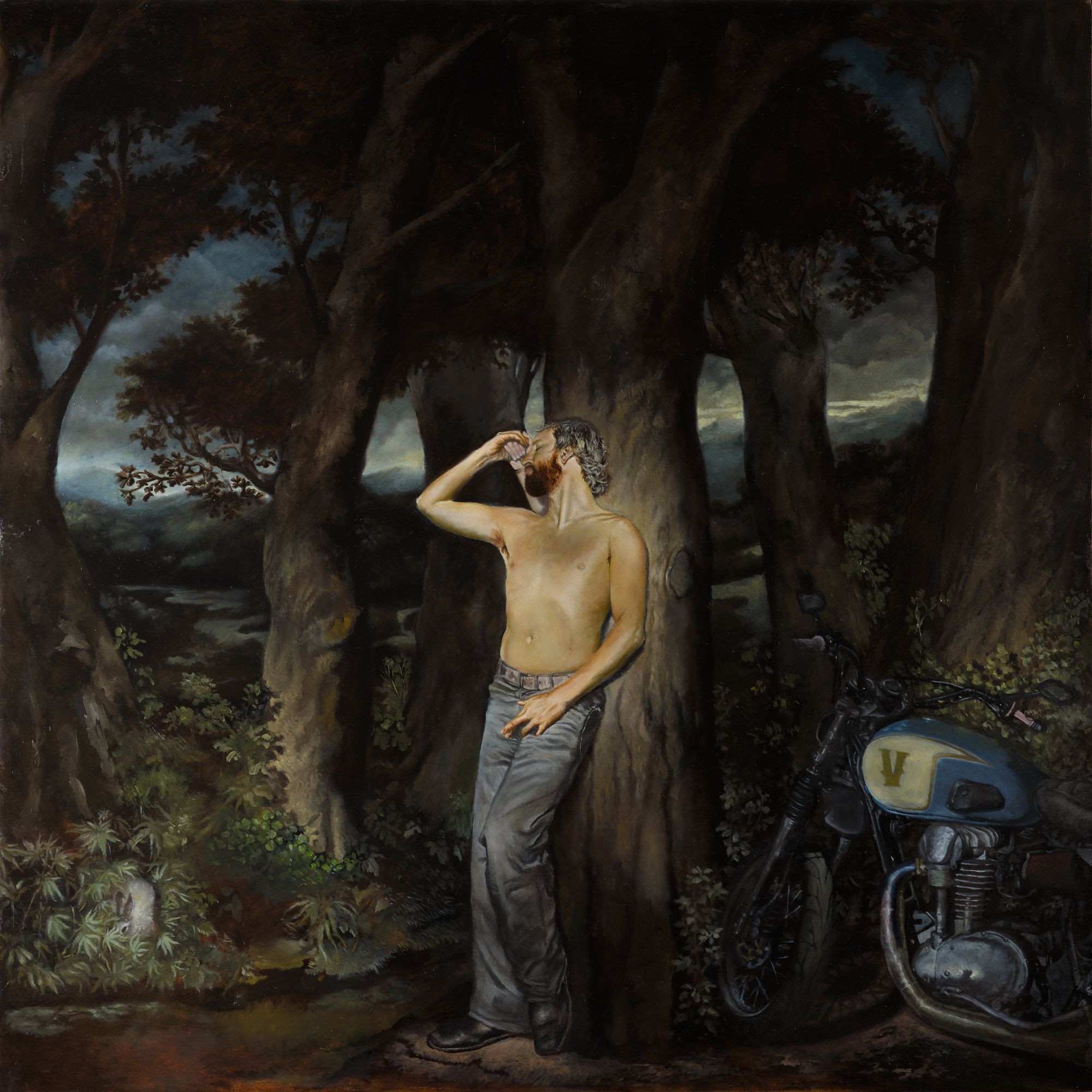
On November 7, Venerus will release his new album. The cover is an oil on panel signed by Andrea Cleopatria, a Milanese artist with whom the musician has been collaborating since 2018 across video clips, artworks, and stage designs: not just a service image, but a listening device that sets tone and expectation before the first note. The painting, Speriamo (1×1 m), depicts a man leaning against a tree, a motorcycle at rest, a shadowy forest, and a line of dawn on the horizon. It does not tell the story of a song: it crystallizes the moment of peace that the music promises to reactivate. The choice of wooden panel and the layered, glazed construction give tactile depth and controlled light: a warm, dense rendering that works as the emotional metronome of the track to come. This creates a co-authorial relationship: the cover does not decorate, it frames the way the album asks to be listened to. Hence the shift from news to critical reading: what we see does not introduce the music, it modulates it. The image defines the entry point of the sound. The painting builds a spatial metric (hierarchies, depth, vectors) that listening translates into temporal metric (anticipation, release, repetition). In other words, the cover foreshadows the architecture of the track. The visual pause, still body, suspended motion, restrained dawn, functions as a pre-delay: it creates a field of emotional pressure before the attack.
Here, image and sound work more by transduction than by translation. The pictorial matter (oil, glazes, wood grain) acts like audio parameters: gentle saturation, controlled dynamics, warm timbre. Not a “visual theme” of the record, but a perceptual algorithm that the brain will apply to listening: what to focus on, how close to hear the voice. Finally, the cover establishes a threshold: more than a frame, it is a listening pact. It sets posture (to stay, breathe, wait) and a possible community (the hand that invites the other). In this way, the image slows down consumption and gives sound back what it often loses in the production chain: a beginning with form.
Interview with Cleopatria, the painter of Venerus' new album's cover, out november 7
How was the iconography of the painting conceived: the forest entrance, the “embracing” tree, the motorcycle, and the hand intertwined behind the trunk?
The idea came from the desire to “freeze” a moment. Taking for granted the inherently “in motion” nature of a musical record, I instead wanted to dwell on the instant when one stops. I imagined Venerus leaning against a tree, immersed in nothingness, seeking a moment of tranquility. The environment is dark, but in the background one glimpses a dawn, a symbol of “hope” along with the left hand, which crosses its fingers in the universal sign.
The motorcycle represents the means of travel, while the hands convey the message: the right hand, in fact, intertwines with another hand, the hand of anyone who wishes to listen.
You spoke of techniques and materials you prepared yourself: what steps did you follow (ground, medium, varnishes) and how did they affect the skin, light, and shading of the scene?
From a technical point of view, I started with a classical base, articulated in various steps. The painting is oil on wooden panel, not on canvas. The first phase concerned the choice of the wood and the preparation of the panel. I use a personal mixture, a sort of recipe I developed over time, as a ground. After applying it, I work the surface to influence both the chromatic rendering and the smoothness of the brush. The dark atmospheres and contrasts with bright lights were obtained through glazes, layering colors that combine and generate nuances. To create them, I start from pigments, which I mix with different oils and mediums depending on the layer. In this painting, I “fattened” the colors a lot with oils, to obtain a particular brightness and brilliance.
Venerus is portrayed “stripped of every ornament.” How did you build the pose and atmosphere? Did you work from live sittings, photographic references, or by letting yourself be guided by listening to the tracks in the studio?
Initially, the pose was different: in the preparatory sketch, Venerus was drawn from behind and dressed. However, once the drawing was transferred onto the panel, the image did not convince me. I felt the need to make it more welcoming. I liked the idea of portraying him without any superfluous element: no bracelets, earrings, or tattoos—as you say, “stripped of ornaments.” The goal was to return to a simple, essential, almost universal human figure. For the initial study of the position, we did some live tests, near a tree, during a free day on tour. When the pose changed, Venerus came to my home for new live studies. One of the most particular aspects of the process was recreating the “forest” setting, a place that didn’t exist, which I built from scratch. I only had the light of a lamp, so it was fun to create the atmosphere and the right light as I painted.
How did the album’s themes influence the palette, light, and composition? And what exactly does the hidden hand intertwined with Venerus’s say about unity and faith in humanity?
The painting and the album were developed in parallel. Some tracks share the same atmospheres as the painting, others seem to belong to different worlds. Yet together, they create a coherent narrative. One can imagine that Venerus, in the painting, is about to start singing the songs of the album, or that he has just sung them. The idea was to highlight a moment different from the moment of the songs themselves. The hand intertwined with Venerus’s, as I mentioned earlier, does not belong to any specific person: it represents a collectivity, a union in listening and in hope. Behind that tree, there could be anyone.
What to read next
Vanilla fragrances are here to stay
Despite everything, they are still the number one choice among female consumers

Liu Jo presents “The Gigi Hadid Edit”
The project that transforms selection into an identity gesture