





























The strange Meta warning about political content “Personalized” politics, Forza Italia in the feed, and chlorine-flavored AI: who asked for this?
A few days ago, during the hours of the referendum, I was scrolling through Facebook looking for something that might catch my attention. Among the posts in my feed, usually ordinary and vaguely aligned with my interests, one from Forza Italia inexplicably appeared. “Sorry we didn’t post anything today, we were all at the beach”: an invitation to abstain from voting, accompanied by an embarrassing AI-generated image (in the picture, the water looked more like a chlorine-sanitized swimming pool). A few hours later, I received a notification from Meta informing me that I might be shown content from political accounts I don’t follow. I quickly disabled the feature, and the ridiculous appearance of Forza Italia made a lot more sense.
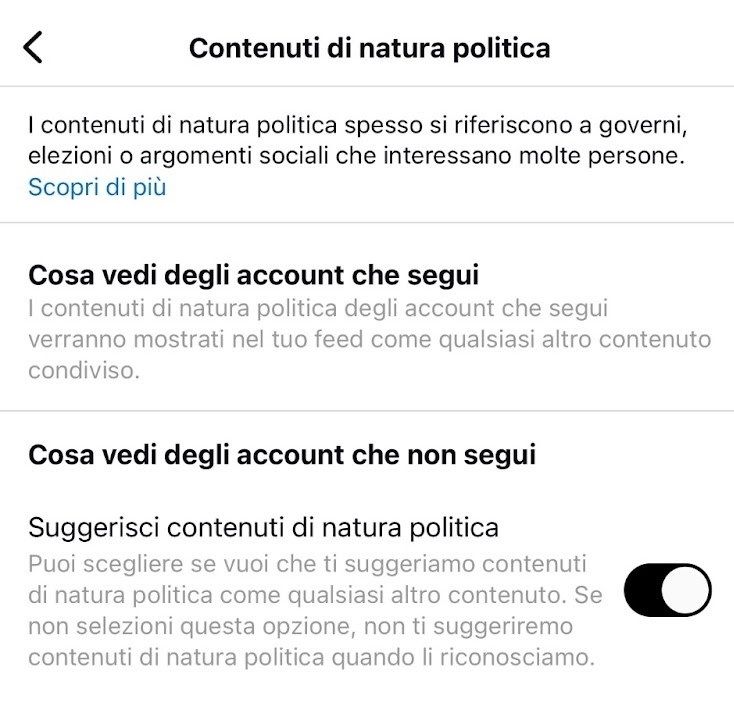
Just over a year ago, Adam Mosseri, Head of Instagram, a role akin to CEO, though at Meta that title is reserved for co-founders, announced that Threads and Instagram would stop recommending political content. The goal, apparently, was “to preserve people’s ability to choose whether or not to engage with political content, respecting individual sensitivity on these topics”, an ironic way of saying: the less I like a post, the less time I’ll spend on the platform, something Meta absolutely cannot afford. According to Mosseri, potential engagement or revenue generated from such content wouldn’t outweigh the risk of attracting criticism, sparking outrage, or compromising the platform’s “integrity.” In other words, they preferred not to recommend political content that might annoy users. This policy shift began in spring 2024; however, starting in January, there was a noticeable reversal, facilitated by the re-election of Donald Trump as President of the United States.
Less oversight, more "freedom of expression", even at the cost of disinformation
Just days before 2025, Mosseri announced in a Threads post that Threads and Instagram would once again start recommending political content. From then on, the introduction of political content would be done in a “responsible and personalized” way, ironically, given that I had never interacted with anything related to Forza Italia. At the same time, CEO Mark Zuckerberg announced a major overhaul in moderation policies for Facebook, Instagram, and Threads, with the stated aim of restoring freedom of speech on the platforms. Following a model already used on other social media, moderation and fact-checking would now rely on Community Notes, that is, user-submitted reports. The focus would be on “illegal and particularly serious” content, while restrictions would be relaxed on topics such as immigration and gender identity. Fact-checking had been introduced on Facebook in 2016 during the U.S. presidential campaigns, after it was proven the platform had been one of the main channels for disinformation. Zuckerberg initially called it “crazy” to think that Facebook had actively influenced the election outcome, he later apologized, acknowledging that the remark was dismissive on such a critical issue.

Brooke Erin Duffy, professor and media scholar at Cornell University, told the BBC that Meta’s decision risks deepening the divide between winners and losers: “Marginalized creator, women, racialized people, and members of the LGBTQ+ community could be exposed to new abuse, with fewer tools for protection,” she said. “At the same time, loosening hate speech regulations might boost the visibility of far-right influencers and ideologically radical figures.”
