

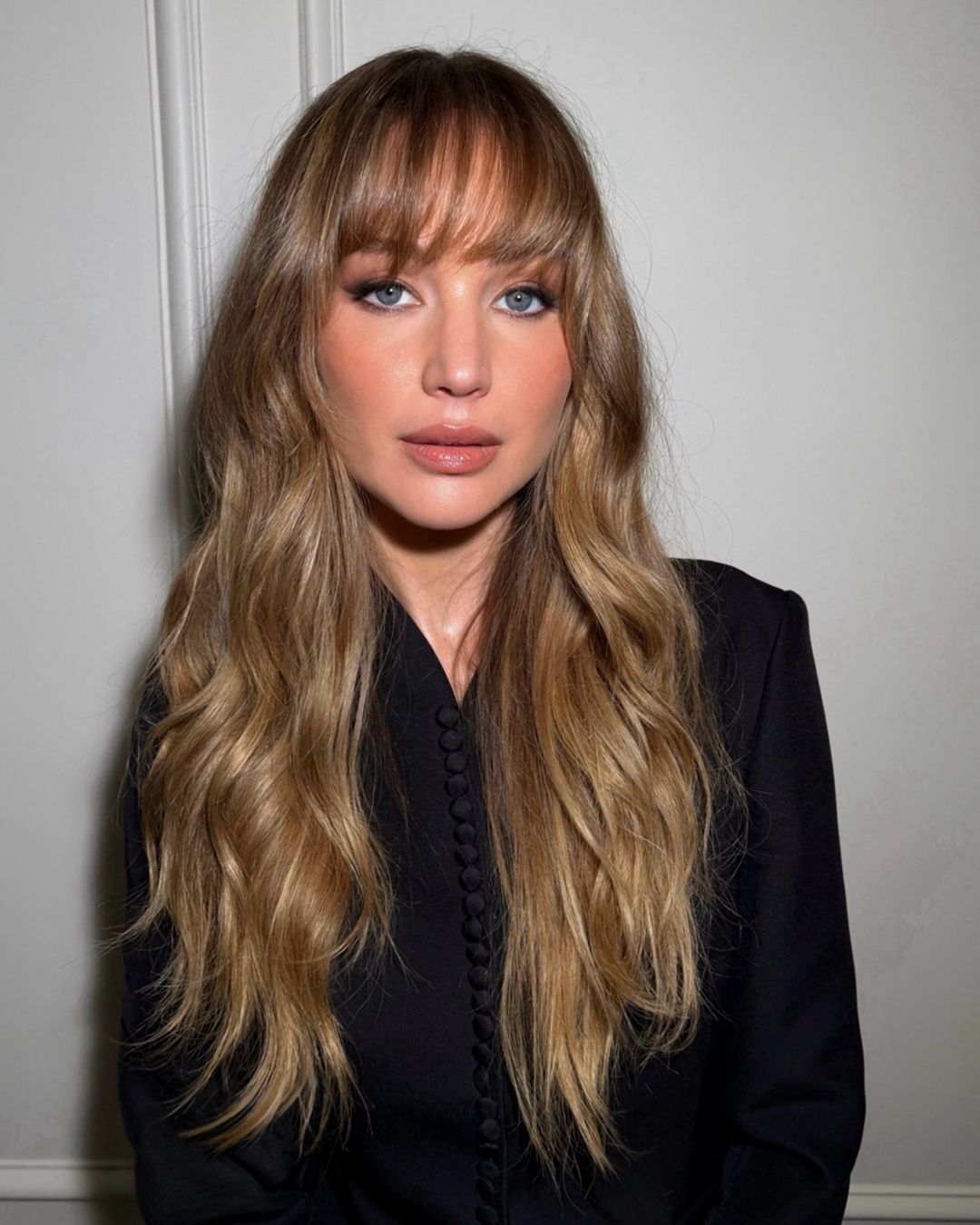
Jennifer Lawrence, blepharoplasty and the obsession with an ever-wider gaze Where did the hooded eyes go?
A Hollywood face doesn’t need to change to end up on trial. Sometimes, all it takes is an eyelid. A recent photo of Jennifer Lawrence, published in The Cut, has become yet another excuse for X’s beauty detectives to compare pictures, angles and millimeters of skin in an attempt to determine whether the actress has undergone blepharoplasty. According to many users, her eyes appear more open and defined than they did in the past. There is no confirmation, however, and similarities between photographs are not medical records. In 2023, Lawrence had already denied rumors of eyelid surgery, attributing the perceived differences to make-up and lighting. She has spoken openly about other cosmetic procedures, from baby Botox to breast surgery after her second pregnancy. Her face has thus become a small laboratory for aesthetic speculation, where every change is interpreted as evidence and every natural expression risks ending up in the “before and after” category. But what does eyelid surgery actually involve?
What is blepharoplasty and how does it work?
If mascara promises to open up the eyes and a lash lift promises to lift them, blepharoplasty works directly on the anatomy. It is a form of eyelid cosmetic surgery that can involve the upper eyelids, lower eyelids or both. In upper blepharoplasty, the surgeon makes an incision along the natural crease of the eye and, when necessary, removes some of the excess eyelid skin. In certain cases, the muscle or fatty tissue may also be addressed. The procedure is generally performed under local anesthesia, sometimes with sedation, and the initial blepharoplasty recovery period often takes one or two weeks, during which swelling and bruising may occur. Lower blepharoplasty, on the other hand, is used to treat under-eye bags and excess skin, through either an external incision or one made inside the eyelid. However, it is important not to confuse hooded eyelids with a condition that necessarily needs correcting. Skin that partially covers the movable eyelid may be related to genetics, age, eyebrow position or tissue distribution. A heavy-looking eyelid does not automatically mean eyelid ptosis, nor does it mean blepharoplasty is the appropriate solution. The so-called fox eye effect, which involves lifting the outer corner of the eyes, may also require different procedures, such as a temporal brow lift. Not every route to more open-looking eyes involves the same operation. Before discussing surgery, it is important to understand which structure is responsible for that appearance.
When too much is removed, the eyes really do change
The eyelid is not a detail to be tweaked like an eyeliner line. It is a delicate structure with a fundamental role in protecting the eye, and removing too much tissue during blepharoplasty can compromise both appearance and movement. Overcorrection can result in sunken eyes, excessively high creases, asymmetry and visible scars. In more serious cases, lagophthalmos may occur, meaning the inability to fully close the eyes, potentially leading to dryness, irritation and damage to the corneal surface. Lower blepharoplasty can cause ectropion, a condition in which the eyelid turns outward, resulting in tearing and irritation. And when the outcome is too aggressive, correcting an overdone blepharoplasty is not always straightforward. Revision eyelid surgery can be more complex and may require grafts, fat transfer or tissue repositioning. This is why eyelid surgery demands experience, precision and a certain degree of caution. It is not simply about removing what appears to be excessive, but about preserving what is necessary.
Have hooded eyes become a flaw?
For years, we have tried to open up our eyes with mascara, eyeliner, contouring, lash lifts and tutorials capable of turning the eyelid into a small exercise in cosmetic engineering. Now even anatomy seems to have made its way onto the list of things to optimize. Online, hooded eye surgery is presented as a way to achieve bigger, brighter and more defined eyes, while hooded eyes risk being treated as a feature that needs correcting. The beauty mechanism is already familiar. A part of the face suddenly becomes undesirable, a procedure appears promising to change it and, some time later, people start discussing how to restore what was removed. Social media accelerates the process, turning photographs into material for analysis and faces into a succession of alleged blepharoplasty before-and-after photos. Jennifer Lawrence has not confirmed any procedure, but the curiosity surrounding her eyes reveals just how accustomed we have become to looking for cosmetic work even when we do not know whether it exists. Hooded eyelids, meanwhile, are neither a diagnosis nor a universal flaw. They are an anatomical feature that can contribute to a person’s facial expressiveness. Surgery can address aesthetic or functional concerns, but not every feature needs to become a problem to solve. After all, trends change faster than tissue. And while the feed moves on to the next eyebrow shape, the result of surgery remains.
What to read next

All's fair is back. Is that a good thing?
The first episodes of season two are now streaming on Disney+
Ugly Betty: twenty years of bad taste and power moves
Twenty years after its debut, America Ferrera, Vanessa Williams, and the cast reunite on Good Morning America