

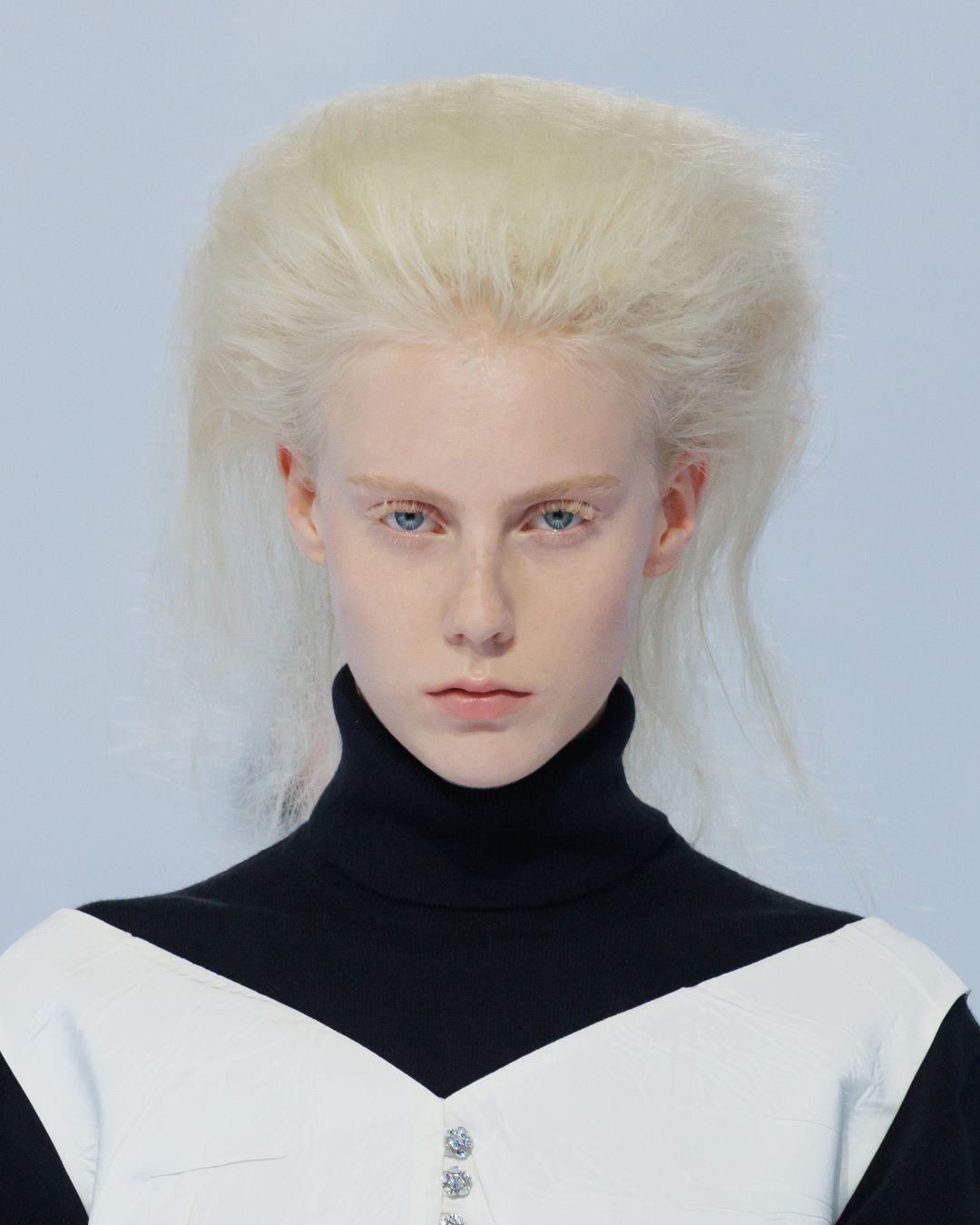
The hairstyles at Milan Fashion Week are so relatable Get your brushes ready: this year it's all about backcombing your hair
This year, at Milan Fashion Week Spring/Summer 2027, hair has decided to forget about perfection. Messy hair is still trending, making its way onto the runways through volume, backcombing, imperfect textures and plenty of personality, drawing heavily from the ’50s, ’70s and ’80s.
The Milan Fashion Week hairstyles are so relatable
The return of backcombing
Backcombing is the first element that seems to have brought together the hairstylists who worked non-stop throughout this Milan Fashion Week. First up, Prada, where hair is big, backcombed and deliberately roughened, with a dry, coarse texture. Marni, meanwhile, brings back the so-called "slap wave" with a new take: a retro, voluminous wave, built around a deep side part and that slightly Old Hollywood movement, only the morning after the red carpet, after sleeping on it. Antonio Marras, on the other hand, takes things quite literally upwards, turning backcombing into towering chignons reminiscent of Gibson Girl hairstyles or those of a 1950s typist.
The claw clip: an evergreen
Then there’s Sportmax, bringing back something we all have at home: the claw clip. For years, it was treated as a passing trend rather than a true hair-styling evergreen. Here, it’s used to pull the hair back in the simplest way possible, so simple that it’s easy to see yourself in one of the models. And that’s exactly the point. The claw clip isn’t elevated or transformed into something else: it stays a claw clip. The one we use at home, keep in our bag, the one we reach for when we have no idea what else to do with our hair.
A little glam rock never hurts
At Cavalli, Gucci and Fendi, meanwhile, ’70s glam rock is back. Hair is wavy, slightly backcombed and messy, with that slightly wild volume that almost looks like it happened by itself. There’s no usual runway perfection here: it’s a more relaxed, dirtier, more nonchalant kind of glamour, as if the hair had simply been allowed to live freely without being forced into perfect, conventional styles.
Imperfection as a sign of credibility
And perhaps this is the common thread running through all these looks: imperfection. Hair no longer needs to look untouchable, but believable, relatable. It’s a little like Miuccia Prada’s approach to the surfaces of her clothes: a crease, an overlap or a distortion doesn’t necessarily need to be corrected. Instead, it can become part of the look, moving away from the idea of perfection and order that for years also defined a certain idea of femininity and domesticity. The same thing is happening with hair. The backcombing remains visible, the wave isn’t precise, the claw clip isn’t hidden and the ends can even look slightly rough. The result doesn’t have to be perfect to work. In fact, it’s that small degree of messiness that makes it feel more current.